


Blog
Second-Hand Vape Aerosol: Crucial Facts Every Aussie Must Know

🔗 Related Health Science Articles
1. What Is Second-Hand Vapor Exposure? Understanding the Basics
When a person vapes, they inhale an aerosol created by heating e-liquid. What they exhale is a mixture of that aerosol combined with their own exhaled breath. This exhaled cloud, known as passive vaping exposure, contains the carrier solvents (propylene glycol and vegetable glycerin) that weren't fully absorbed, nicotine and flavoring chemicals that weren't retained in the lungs, and trace metals and other by-products generated during heating (at much lower levels than in cigarette smoke).
This cloud does not hang in the air indefinitely. Its particles behave differently from cigarette smoke because they are larger and formed from liquids rather than solid combustion particles—a key distinction when discussing indoor vape risks. For a deeper understanding of what's actually in the aerosol, our article 7 Common Vaping Myths Debunked addresses common misconceptions about e-liquid ingredients.
2. How It Differs from Second-Hand Cigarette Smoke: 5 Critical Distinctions
This distinction is critical and often misunderstood. The absence of combustion changes everything. To understand second-hand vape aerosol, we must first understand how it differs fundamentally from smoke. Here are five essential facts that separate the two.
🚬 Second-Hand Cigarette Smoke
- Combustion-based: Contains thousands of chemicals from burning tobacco and paper
- High in toxins: Includes known carcinogens (benzene, formaldehyde), carbon monoxide, and tar
- Persistent: Smoke particles can linger for hours and deeply penetrate fabrics
- Established harm: Causally linked to lung cancer, heart disease, and SIDS in non-smokers
💨 Second-Hand Vape Aerosol
- No combustion: Lacks tar and carbon monoxide entirely
- Lower toxicant levels: Contains fewer and generally lower concentrations of harmful chemicals
- Different particle behavior: Aerosol droplets evaporate and disperse more rapidly than smoke particles
- Long-term effects unknown: No long-term studies on passive exposure exist yet
This does not mean second-hand vape aerosol is safe—it means the risk profile is different. The primary concern shifts from the well-documented dangers of combustion by-products to questions about nicotine exposure, respiratory irritation, and the unknown effects of long-term inhalation. For more on specific health concerns, read our deep dive into Popcorn Lung and Vaping: Separating Myth from Medical Fact.
3. Indoor Realities: What Settles, What Lingers, What Clears
Several factors determine what happens to exhaled aerosol in an indoor space. Understanding these dynamics is essential for assessing indoor vape risks accurately.
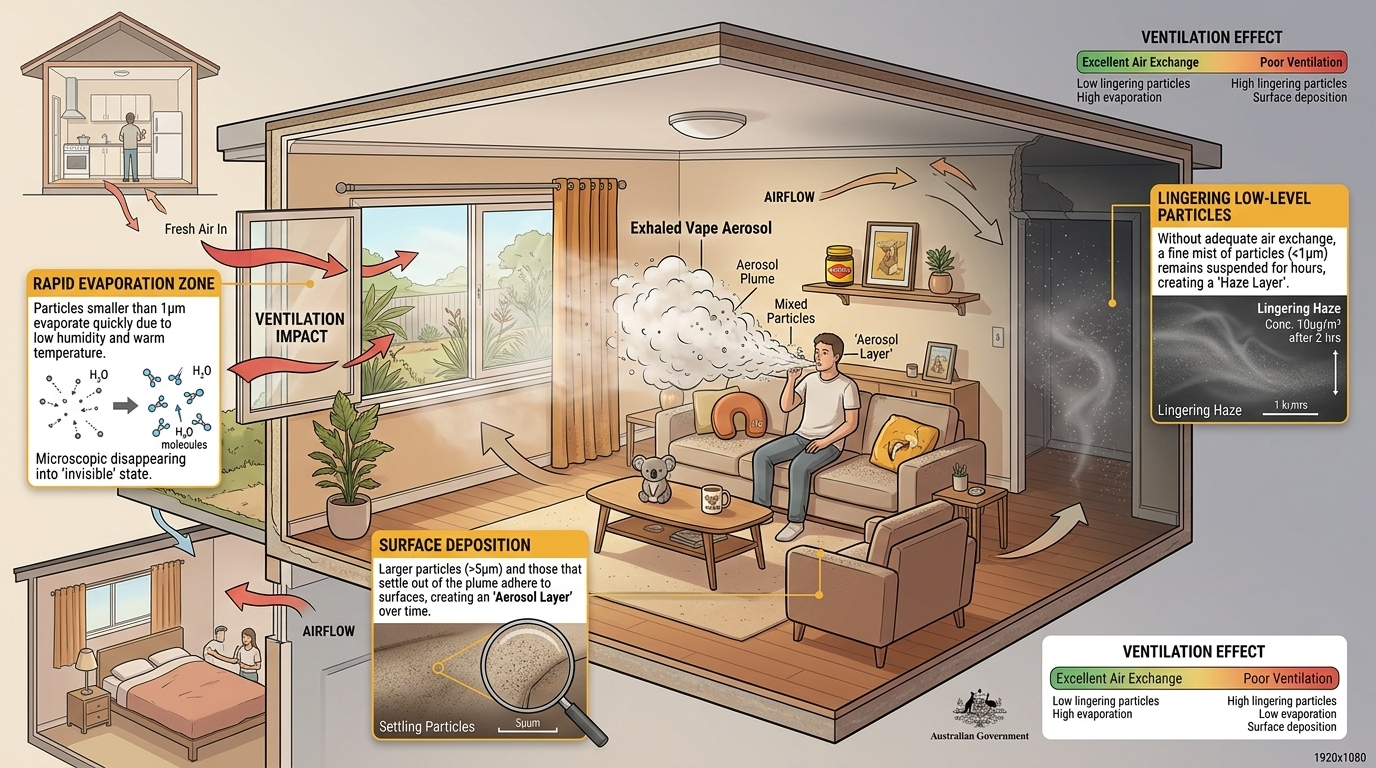
- Rapid evaporation: The propylene glycol and vegetable glycerin droplets begin to evaporate within seconds, reducing the airborne particle concentration.
- Surface deposition: Some of the larger droplets and the non-volatile components (nicotine, flavorings, metals) settle on nearby surfaces—furniture, carpets, curtains, and skin. This is sometimes called third-hand vape residue.
- Air exchange: Opening windows or using ventilation dramatically accelerates the removal of airborne residue. In a poorly ventilated room, low levels of nicotine and other compounds can persist.
Studies measuring indoor air quality after vaping sessions have detected increases in particulate matter (PM2.5) and nicotine, but at levels significantly lower than those found in rooms where smoking occurred. The clinical significance of these levels for bystanders over years is not yet established.
A Note on Third-Hand Exposure
Third-hand refers to residue that settles on surfaces and potentially re-emits or reacts with other chemicals (like ozone) to form new compounds. While this is a real phenomenon for both smoke and vape aerosol, the concentrations from vaping are substantially lower. For most households, routine cleaning is sufficient. The exception is environments with very young children who mouth surfaces—in those cases, extra care is reasonable when considering third-hand vape residue.
4. Practical Advice for Homes and Shared Spaces: 4 Essential Tips
Based on current evidence and the precautionary principle, here is realistic guidance for households concerned about passive vaping exposure.
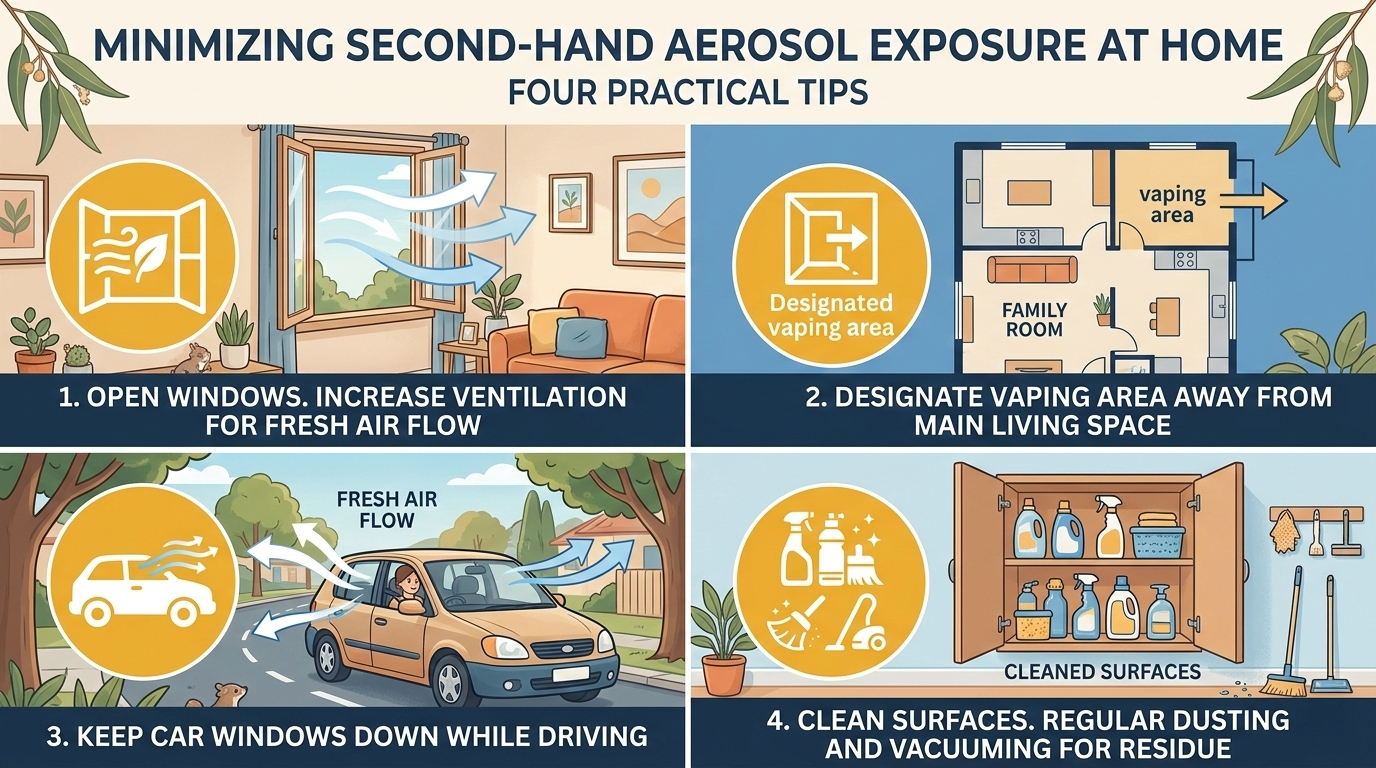
1. Ventilation is your friend
Vaping near an open window or door, or using an exhaust fan, rapidly reduces airborne residues. It's a simple step that makes a measurable difference.
2. Designate a space
If someone in the home vapes frequently, consider doing it in a well-ventilated area away from where people spend most of their time—as a courtesy and to minimize surface deposition.
3. Avoid enclosed shared spaces
In a car with the windows up, aerosol can build up quickly. If sharing a car with non-smokers/non-vapers, it's reasonable to either not vape or ensure full ventilation.
4. Surface residue
Nicotine and flavorings can settle on surfaces. Regular cleaning (dusting, vacuuming) is sensible, just as it is for general household hygiene. There's no evidence this poses a significant health risk, but it's an easy precaution.
5. Considerations for Children and Pregnant Women
This is where the precautionary principle is most relevant. We lack long-term data on passive vaping exposure, so advice is based on what we know about the constituents and a desire to minimize unnecessary risk. For a broader perspective on health considerations, our guide Can Vaping Help You Quit Smoking? A 2026 Evidence Check provides context on who may benefit from vaping and who should avoid it.
- Children: Their developing lungs and bodies may be more susceptible to respiratory irritants. While the levels of toxicants in second-hand aerosol are far lower than in smoke, it is prudent to avoid regular exposure in enclosed spaces. This doesn't mean panic—it means creating a simple habit of vaping away from children or ventilating well.
- Pregnancy: Nicotine is a developmental toxicant that can affect fetal brain and lung development. While the primary risk is from active maternal use, minimizing any unnecessary nicotine exposure during pregnancy is standard medical advice. This includes avoiding being in enclosed spaces where vaping occurs regularly.
Four Facts We Hold at the Centre of This Discussion
- Nicotine is addictive — for both the user and, if absorbed, a bystander (though absorption from second-hand aerosol is much lower than from smoke).
- Vaping is not without health risks, and this extends to passive exposure, though the risk profile is different from smoke.
- Compared to second-hand smoke, the risk from second-hand aerosol is generally lower because it lacks combustion products.
- For many, vaping is a transition away from smoking. Understanding second-hand vape aerosol helps households make balanced, informed decisions—not fear-based ones.
Placing It in Perspective: Smoke vs. Vapor Indoors
It's important not to equate the two. Allowing someone to smoke indoors exposes bystanders to a mixture with proven, severe health risks. Allowing someone to vape indoors exposes them to an aerosol with lower levels of toxicants and unknown long-term effects. These are different situations, and they call for different responses.
If a household includes both smokers and vapers, the priority should be eliminating indoor smoking first, as its harms are unequivocal and large. For vaping, the approach can be more nuanced: ventilation, designated areas, and extra care around vulnerable individuals are reasonable steps for managing indoor vape risks.
📖 Deepen Your Understanding
Conclusion: Informed Caution, Not Fear
Second-hand vape aerosol is real, and it contains nicotine and other compounds. It is not harmless, but it is also not the same as second-hand cigarette smoke. The difference lies in the absence of combustion and the vastly lower levels of toxicants.
For most households, simple steps—ventilation, common-sense separation, and regular cleaning—are sufficient to minimize exposure. For homes with children or pregnant women, a slightly more cautious approach is reasonable, given the unknowns and the developmental effects of nicotine.
As with all health topics, the goal is to provide clear information, acknowledge uncertainty, and respect that real people make real choices in complex circumstances. By understanding these 5 essential facts, you can make informed decisions for your household.
🇦🇺 G'DayVape perspective: We believe in providing clear, evidence-based information to help Australian adults make informed decisions. Understanding passive vaping exposure allows households to create comfortable shared spaces while respecting individual choices. For more myth-busting health information, explore our related guides above.
📚 References & Authoritative Sources
- Therapeutic Goods Administration (TGA). (2026). Nicotine Vaping Products: Health Information. Australian Government Department of Health. tga.gov.au
- Australian Government Department of Health and Aged Care. (2026). About vaping and e-cigarettes. health.gov.au
- National Health and Medical Research Council (NHMRC). (2025). Health Advice on Vaping: Evidence-Based Information. nhmrc.gov.au
- Cancer Council Australia. (2025). Position Statement: Electronic Cigarettes and Passive Exposure. cancer.org.au
- Australian Institute of Health and Welfare (AIHW). (2025). National Drug Strategy Household Survey: Vaping Statistics. aihw.gov.au
All external sources are Australian government or official health institutions. Links are dofollow and open in new tabs. Information current as of March 2026.
© 2026 G'DayVape — Australian vape knowledge, grounded in clarity. Always adult-only. This guide is for informational purposes only and does not constitute medical advice. Always consult healthcare professionals for personal health decisions.
 RELX Pod