
Blog
Is Nicotine Vape Legal in Australia 2026? Current Rules & Reality


The Short Answer: Conditional Legality
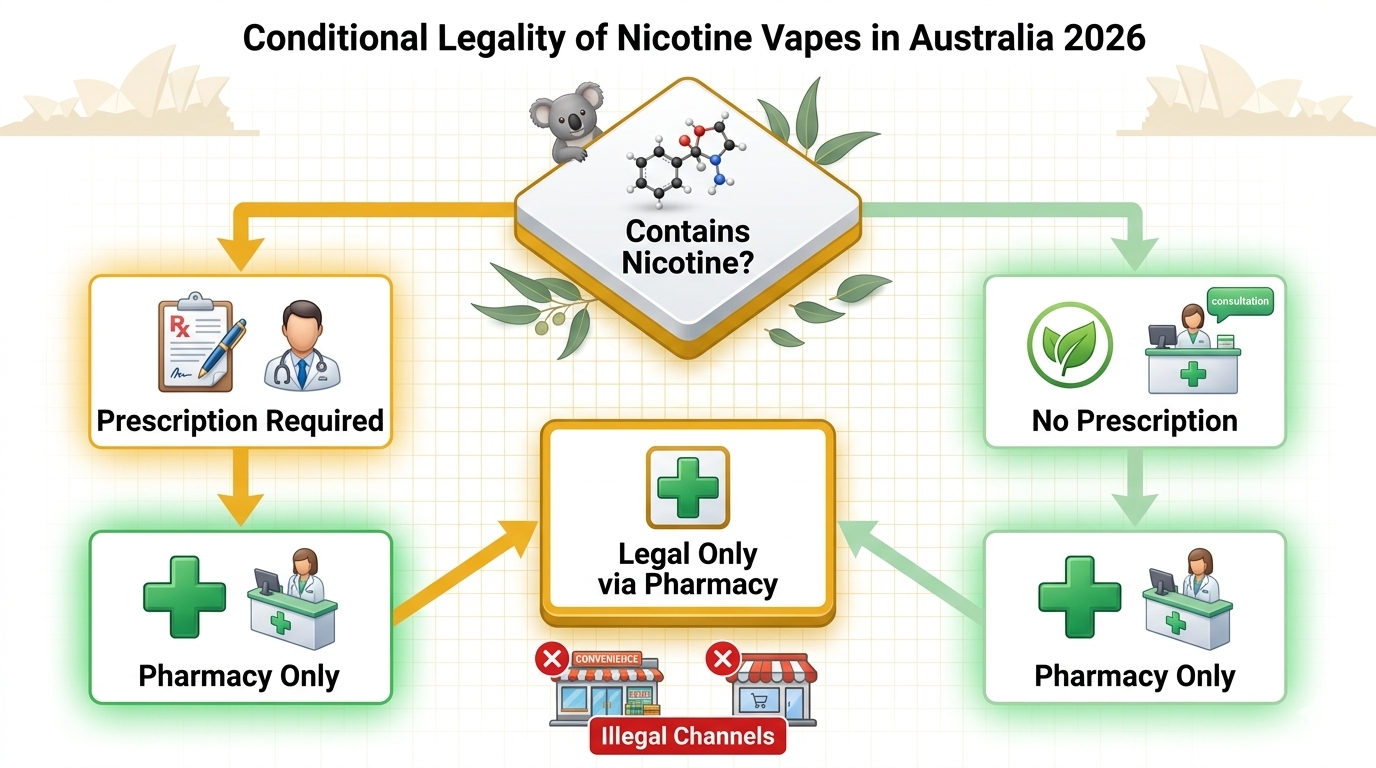
In 2026, nicotine vaping products (NVPs) are legal in Australia only as Schedule 4 (Prescription Only) medicines [1]. This means they are not banned outright, but their legality is conditional upon medical authorisation and access through pharmacies [8].
| Activity / Scenario | Legal Status (2026) | Key Condition / Notes |
|---|---|---|
| Possessing nicotine vape WITH a valid prescription | ✅ LEGAL | Must be for personal use. Product should be obtained via pharmacy or legal import [1]. |
| Purchasing nicotine vape from a PHARMACY with prescription | ✅ LEGAL | This is the primary intended legal retail pathway [8]. |
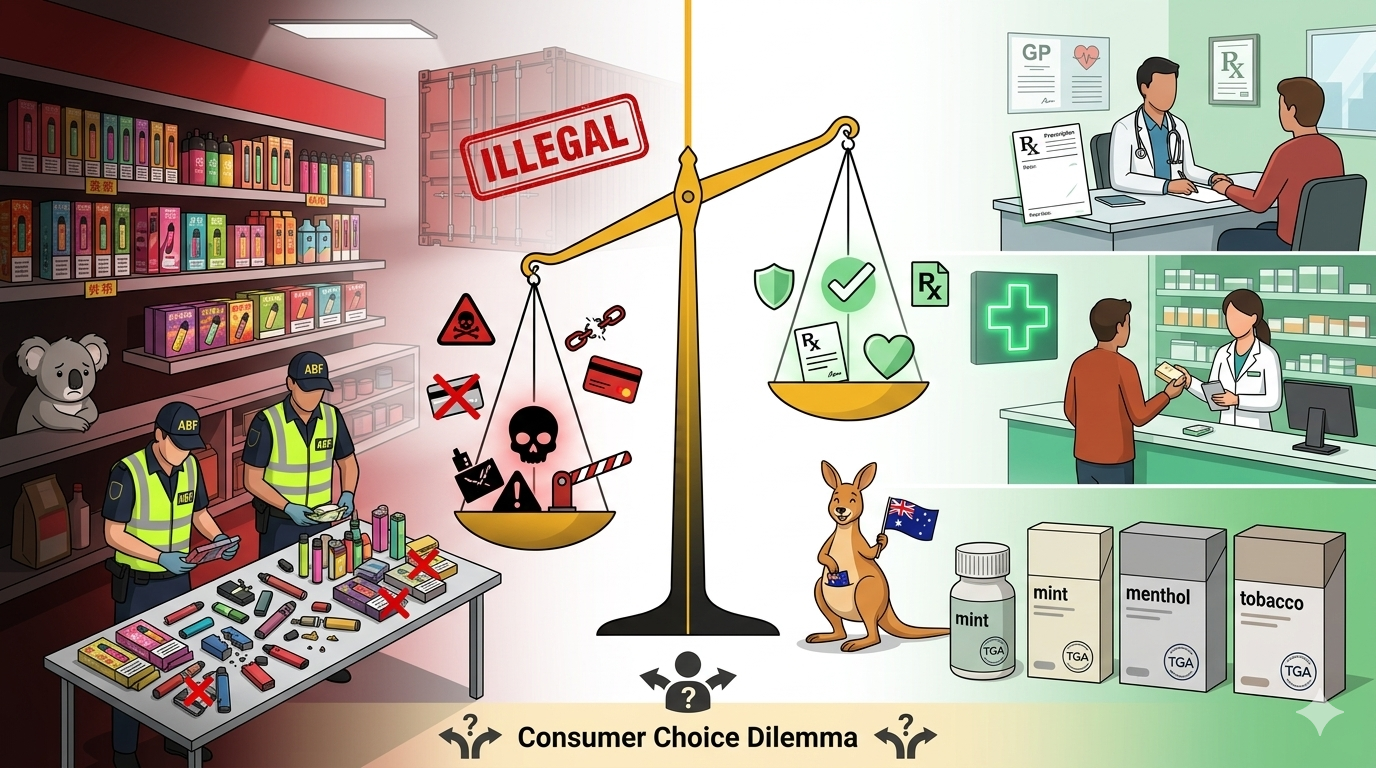
| Purchasing nicotine vape from a RETAIL STORE (convenience, vape shop) | ❌ ILLEGAL | Sale of nicotine vapes outside pharmacies is prohibited nationwide [5][8]. |
| Importing nicotine vape for personal use WITHOUT a prescription | ❌ ILLEGAL | Australian Border Force (ABF) will seize non-compliant shipments [3]. |
| Importing nicotine vape for personal use WITH a prescription | ✅ CONDITIONALLY LEGAL | Allowed under TGA's Personal Importation Scheme (3-month max supply) [4]. |
| Commercial import/sale without license | ❌ ILLEGAL | Heavy penalties apply. This is a primary enforcement target [2][3]. |
The Official Legal Status: Schedule 4 Prescription Medicine
Under Australian law, nicotine (when not in tobacco form) is classified as a Schedule 4 substance in the Poisons Standard [4]. This legal classification, enforced by the Therapeutic Goods Administration (TGA), is the foundation of all regulations [1].
What "Schedule 4 (Prescription Only)" means
- Nicotine vaping products are considered therapeutic goods, specifically for smoking cessation [1].
- They cannot be sold as consumer products in shops [5].
- Access is restricted to individuals who have obtained a prescription from a qualified medical practitioner [8].
- The products themselves must meet specific quality and safety standards (TGO 110) [1].
Key Distinction: This model treats nicotine vapes similarly to other prescription medications—they are legal for therapeutic use under supervision, not for recreational use. The policy intent is to frame them as a medical tool to help smokers quit, not as a consumer lifestyle product [8].
The "Pharmacy-Only" Access Model
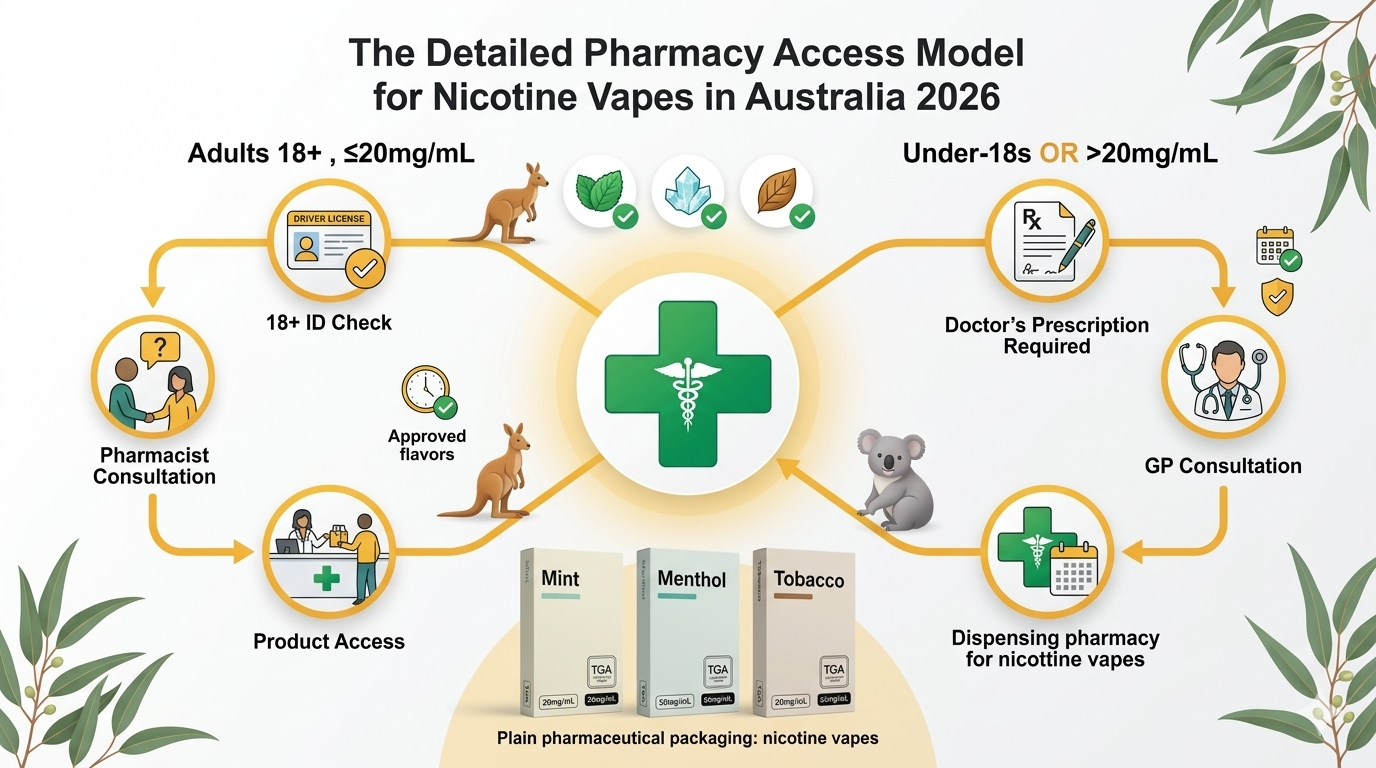
Since 1 July 2024, Australian law has established a single point of legal retail access for all vaping products: pharmacies [5][8]. This works alongside the prescription rule:
Step 1: Consult GP
Step 2: Receive Prescription
Step 3: Visit Pharmacy
Step 4: Pharmacist Dispenses
Since 1 October 2024, people 18 years and older can buy therapeutic vapes from participating pharmacies with a nicotine concentration of 20 mg/mL or less without a prescription, subject to certain conditions and where state and territory laws allow [5][8]. However, they must talk with the pharmacist before purchasing, including discussing the product and dosage, discussing other options to quit smoking, and providing identification for proof of age [8].
People under 18 years need a prescription to access therapeutic vapes, where clinically appropriate and where state and territory laws allow [5][8]. People who need therapeutic vapes with a higher concentration of nicotine than 20 mg/mL also need a prescription, regardless of age [5][8].
Flavours are restricted to mint, menthol and tobacco, and vapes must adhere to plain pharmaceutical packaging standards [5][8].
Law vs. Reality in Australia: The Enforcement Gap
Understanding the law is one thing; understanding how it's enforced is another. There's a significant gap between the theoretical legal framework and the practical reality on the ground [2].
Enforcement Priorities vs. Practical Reality
Government agencies like the TGA and Australian Border Force (ABF) publicly state their focus is on the supply side of the illicit market [2][3]. However, the reality is more complex:
- Official Priority: Stopping commercial imports and shutting down illegal retailers [2][3].
- Market Reality: Widespread availability of non-compliant products in convenience stores and online [10].
- Consumer Reality: Many users access products through informal channels despite the prescription requirement.
- Enforcement Reality: Resources are limited, creating a significant gap between the law on paper and its application in practice [10].
The stated intent is not to penalise individual adult users for possession, especially if for personal use. However, possession without a prescription remains technically illegal [1].
The Illicit Market Reality
Despite the strict laws, a large illicit market exists. Many products sold as "nicotine-free" in convenience stores and online actually contain nicotine [10]. This creates risks for consumers (unknown quality, unregulated ingredients) and represents the main challenge for regulators.
The persistence of this market highlights the difficulty of enforcing a prescription-only model when demand remains high. In South Australia, possession of 2 or more vapes is presumed to be for sale, attracting penalties up to $6.6 million [1]. NSW Police and ABF recently seized over $1.6 million worth of illegal tobacco and vapes in a single operation [7].
How to Legally Access Nicotine Vapes in 2026
For adults who wish to access nicotine vapes within the law, the process is straightforward but requires following the medical pathway [1][8]:
- Consult a Medical Practitioner: Discuss your smoking history and desire to quit with your GP or a doctor via an authorised telehealth service.
- Obtain a Prescription: If deemed appropriate for smoking cessation, the doctor will issue a prescription (valid for specific products/quantities).
- Access the Product:
- From a Pharmacy: Present your prescription at a pharmacy that dispenses TGA-approved nicotine vaping products.
- Via Personal Import: Use the prescription to order from an overseas website under the TGA's Personal Importation Scheme, ensuring the shipment includes the required documentation [4].
Common Vape Misconceptions Explained
- ❌ "If I can buy it in a store, it's legal."
Reality: The sale of any nicotine vape in a non-pharmacy retail setting is illegal. The presence of a product in a store indicates an active illicit market, not legality [5]. Products may be mislabelled or contain undeclared nicotine. - ❌ "The laws are about to change to make it easier."
Reality: The government's stated policy direction as of 2026 remains firmly committed to the prescription model and reducing youth access [2]. Any future changes would likely involve further tightening of product standards, not loosening of access. - ❌ "I won't get in trouble for having a small amount for personal use."
Reality: Technically risky. While enforcement focuses on suppliers, possession without a prescription is still against the law [1]. The risk, while low for pure personal use, is not zero. - ❌ "All vapes are banned in Australia."
Reality: Incorrect. Nicotine vapes are not banned—they are regulated as prescription medicine. Non-nicotine vapes face sales restrictions but are not prescription-only. The policy is about controlled access, not blanket prohibition [8].
TGA 2026–27 Compliance Priorities
In January 2026, the TGA announced its new compliance principles for 2026–2027, explicitly listing vaping goods among 12 priority focus areas for the first quarter of 2026 [2][6]. Key actions include [2]:
- Proactive scrutiny of advertising, particularly across digital environments (social media, influencer content).
- Action against unapproved and falsified products supplied via e-commerce.
- Countering AI-generated misinformation and deceptive endorsements.
- Strengthening enforcement visibility and targeting non-compliance in digital channels.
The priority list is reviewed quarterly, with vaping remaining a sustained focus [2][6].
State Variations and Penalties
Laws vary by state. For example:
- South Australia: Possession of 2 or more vapes is presumed for sale. Penalties up to $6.6 million for commercial quantities [1].
- NSW: Recent operations seized $1.6 million worth of illegal products; individuals charged with "possess commercial quantity of vaping goods" [7].
- WA: Parliamentary debate ongoing to strengthen penalties and introduce long-term closure orders for repeat offenders [10].
Conclusion: A Conditional Legality Shaped by Public Health
So, are nicotine vapes legal in Australia in 2026? The definitive answer is: they are legal only within a strict, medically-supervised framework [1][8].
Australia's approach is defined by its public health goals: to provide a quitting aid for current smokers while preventing uptake by non-smokers, particularly youth [8]. This results in a system where legality is conditional on a prescription and access is confined to pharmacies.
The reality, however, includes a significant gap between the law and its enforcement, with a thriving illicit market [10]. For smokers seeking a legal pathway, the prescription model provides regulated access. For policymakers, the challenge remains closing the enforcement gap [2].
🇦🇺 G'DayVape difference: We're committed to providing accurate, up-to-date information to help Australian vapers stay compliant. All products featured on our site are for informational purposes only—always follow legal channels for purchase.
📚 References & trusted sources
- Therapeutic Goods Administration (TGA) – Nicotine Vaping Products Hub. tga.gov.au [Official information on prescription-only status and regulation of NVPs]
- Holding Redlich (Legal Insight) – TGA's 2026-27 compliance principles and focus areas. holdingredlich.com [Detailed analysis of TGA enforcement priorities including vaping goods]
- Australian Border Force (ABF) – Billion-dollar breach: ABF remains on front foot of tobacco targeting (March 2026). abf.gov.au [Official seizure statistics and enforcement update]
- TGA – Personal Importation Scheme – Guidelines for legally importing nicotine vaping products. tga.gov.au [Valid prescription and quantity limits]
- The Sydney Children's Hospitals Network (NSW Health) – Laws in Australia (vaping and smoking). health.nsw.gov.au [Current e-cigarette laws, pharmacy access, age restrictions]
- 2Firsts – TGA Sets 2026–2027 Compliance Principles, Flags Vaping Goods as a 2026 Priority. 2firsts.com [TGA priority areas including vaping goods]
- NSW Police – Two charged, $1.6 million worth of illicit tobacco and vapes seized - Riverwood (Jan 2026). police.nsw.gov.au [Real-world enforcement example and penalties]
- Department of Health and Aged Care – Vaping laws. health.gov.au [Official government overview of vaping reforms, pharmacy model, and access rules]
- Legal Services Commission of South Australia – Tobacco and E-cigarettes (Law Handbook). lsc.sa.gov.au [State-specific penalties, possession limits, and enforcement]
- Parliament of Western Australia – Hansard: Tobacco Products Control Amendment Bill 2026 (Feb 2026). parliament.wa.gov.au [Parliamentary debate on illicit market and enforcement challenges]
All sources are government, academic, or legal organisations. Retrieved March 2026.
© 2026 G'DayVape — Australian vape knowledge, grounded in clarity. Always adult-only.
 RELX Pod