

Blog
What Happens to Disposable Vapes After Use? (Australia Guide 2026)

The Hidden Life of a Disposable Vape
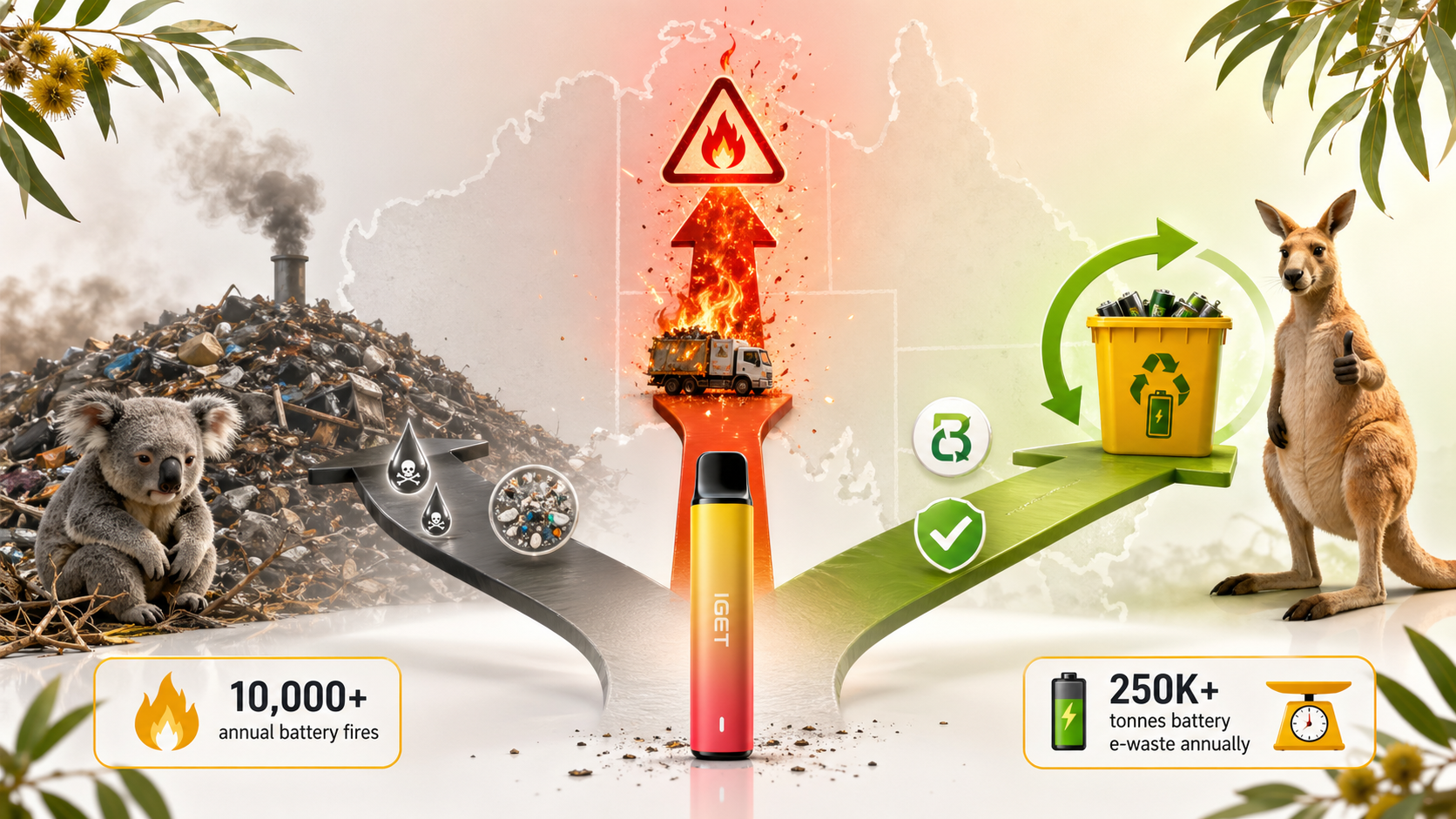
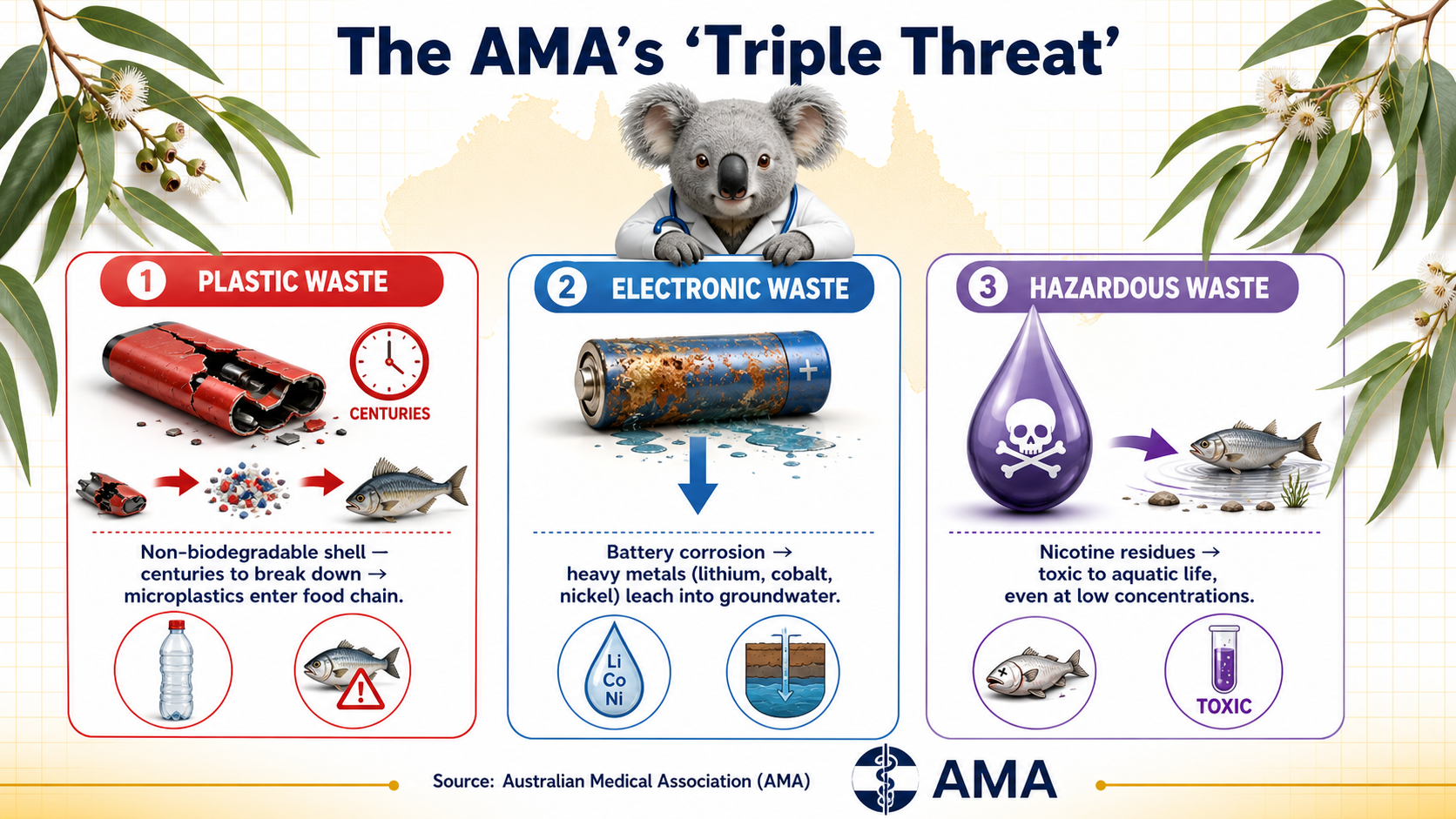
You take your last puff, drop the device in a public bin, and it vanishes from sight. But out of sight does not mean gone. A single discarded vape is a compact time bomb of hazardous materials: a lithium‑ion battery, a non‑biodegradable plastic shell, a metal heating coil, a circuit board, residues of nicotine salts, and trace heavy metals. Together, they create what the Australian Medical Association calls an “environmental triple‑threat” —plastic waste, electronic waste (e‑waste) and hazardous waste all in one palm‑sized device [1].
Imports of disposable vapes have been illegal since 1 January 2024, and their domestic supply was banned from 1 July 2024. But millions of devices bought before the ban are still in circulation, and growing numbers of illegal imports continue to be seized at the border [2]. For every vape that ends up in the environment, a chain of consequences is set in motion.
What's Hidden Inside a Single Disposable Vape
✅ Sealed lithium‑ion battery (explosive if crushed)
✅ Non‑biodegradable plastic shell + pod
✅ Metal heating coil with traces of nickel/chromium
✅ Printed circuit board with soldered components
✅ Nicotine residues (toxic to aquatic life & pets)
✅ Traces of heavy metals (lithium, copper, tin)
✅ Remaining e‑liquid (contains propylene glycol)
Path One: The Household Bin – Where Most Vapes End Up
Despite widespread warnings, the majority of used disposable vapes still end up in kerbside general waste bins. This is the most dangerous outcome for both people and the environment.
Garbage Truck Fires: The Immediate Danger
When a general waste or recycling truck compresses its load, any embedded lithium‑ion battery can be punctured. The result is thermal runaway — a self‑sustaining chemical reaction that releases explosive gases and intense heat, often causing a fire inside the truck. Australian industry research shows there are around 30 battery fires each day across the nation’s waste and recycling services — more than 10,000 a year [3]. The Queensland Fire Department alone recorded more than 200 battery‑sparked fires in the first 11 months of 2025, averaging about one fire every two days [4].
From Truck to Landfill: Long‑Term Environmental Leaching
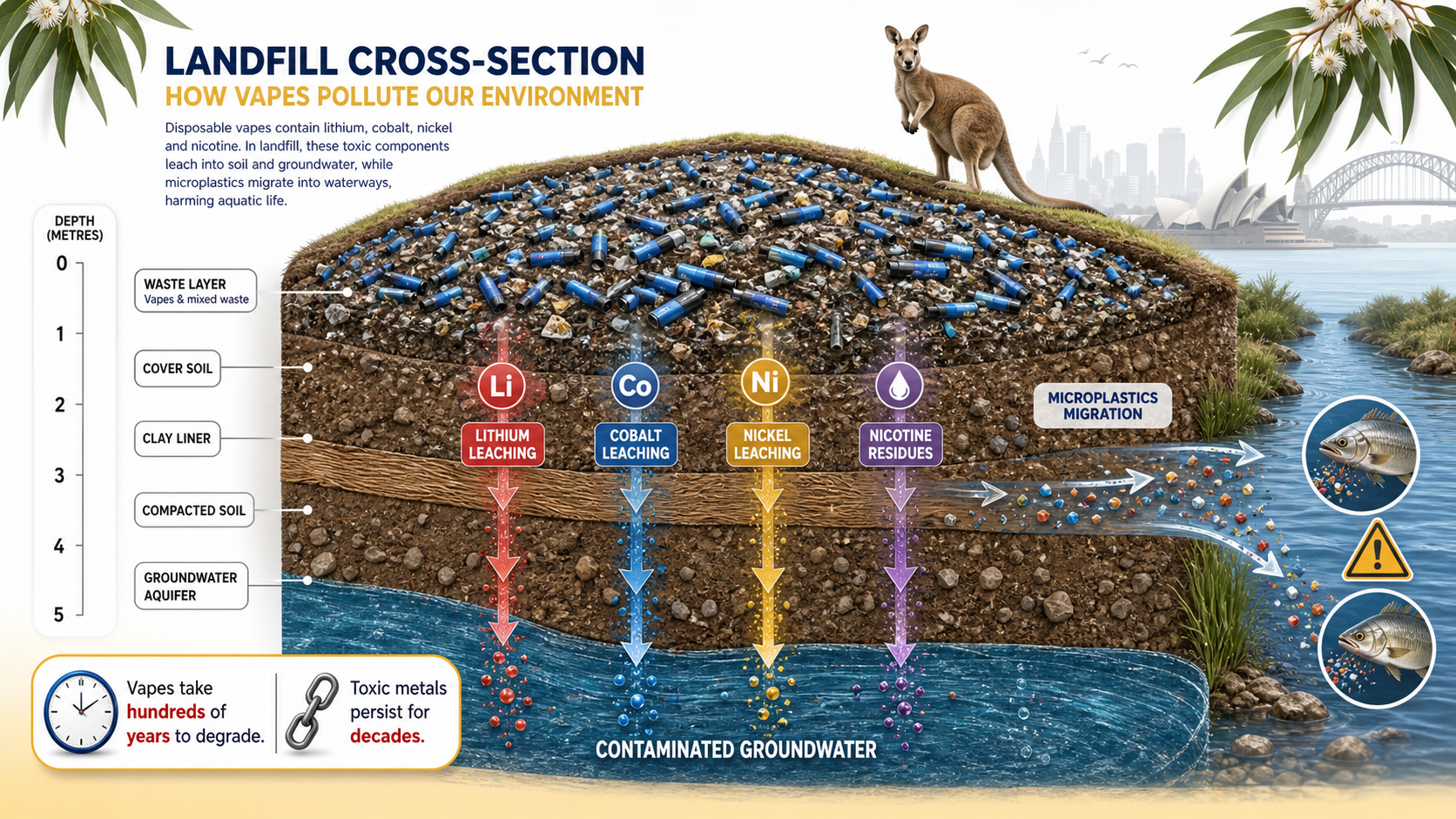
Vapes that survive the journey to landfill do not decompose. The plastic shell takes hundreds of years to break down, eventually fragmenting into microplastics that contaminate soil and waterways. The lithium‑ion batteries corrode and leak heavy metals — including lithium, cobalt, nickel and copper — directly into groundwater [1]. Nicotine residues, which are highly toxic to fish and other aquatic organisms, also leach out. The AMA warns that this contamination can pollute the soil and water “long into the future” [1].
Path Two: The Black Market – From Shelves to Cash Flow
Under a third of all vapes used in Australia are now thought to be sourced legally via pharmacies. The rest are diverted from the sprawling illicit market — goods that were either imported illegally or diverted after landing. And that illegal supply chain comes with an increasingly violent criminal ecosystem.
In April 2026, shots were fired from a white Hilux into a suburban shisha bar in Altona North, striking a 49‑year‑old man in the arm. Victoria Police’s Gang Crime Squad believes the attack is tied to the illicit tobacco and vape trade [5].
Taskforce Lunar has executed more than 350 raids and made at least 212 arrests. More than $50 million in cash, illegal cigarettes, tobacco and vapes have been seized [5].
Under NDG Operation TEMPEST26, authorities seized nearly 100,000 vaping devices during a coordinated crackdown across NSW and the ACT [6].
The story does not end with a vape being thrown away. In one way, it marks the start of a far more troubling lifecycle — one where hazardous waste is fuelled by organised crime. The public, meanwhile, are often none the wiser about where their used devices truly end up.
Path Three: The Recycling Bin – The Only Responsible Exit
The small number of vapes that are correctly disposed of through dedicated channels enter an altogether different journey — one that ends not with toxic contamination or a fire, but with material recovery and reuse.
B‑cycle: Australia’s National Battery Stewardship Scheme
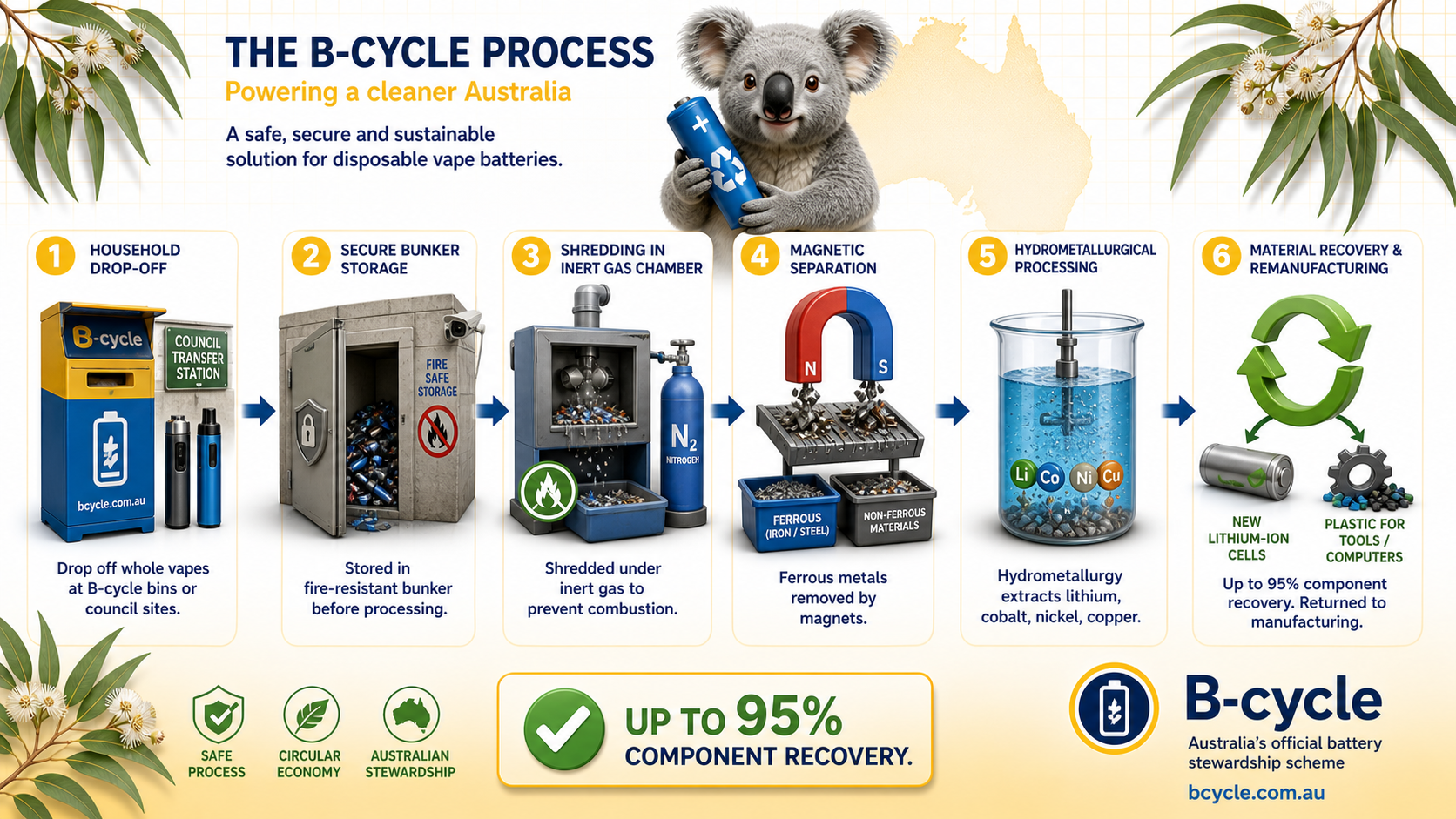
B‑cycle is the government‑backed scheme for recycling loose batteries weighing 5 kilograms or less. Many councils are also accredited B‑cycle stewards, which means they accept whole disposable vapes at transfer stations and B‑cycle collection points [7]. The scheme can recover up to 95% of a battery’s components, turning them into new batteries or industrial materials [7].
Partnerships That Work: EcoSig & Council Networks
Lockyer Valley Regional Council has partnered with EcoSig, an organisation that specialises in recycling lithium‑ion batteries, metal, plastic and cotton from vapes. The recovered lithium batteries are recycled into new power banks, while remaining products are recycled where possible or made safe and properly disposed. Used disposable vapes can be dropped off free of charge at multiple transfer stations in the region [8]. Over 9,000 kilograms of embedded battery waste has already been collected through NSW’s trial CRC network [9].
What About the Remaining Illegal Stockpiles?
The disposable vape import ban does not magically remove devices already in Australia — or stop new shipments from slipping through. Every illegal vape that is used and then incorrectly disposed of adds to the waste mountain and increases fire risk. Authorities continue to seize large hauls: in April 2026, a single Sydney operation confiscated 30,000 illegal vaping goods with an estimated street value of $1.8 million, and a second‑quarter sweep across NSW and the ACT netted 98,500 vaping devices [6]. These seizures highlight the immense scale of the challenge that regulators and recyclers still face.
A Smarter Path: Reusable Pod Systems = Less Waste
Every month you use a rechargeable pod system instead of a disposable, you prevent a lithium‑ion battery, a plastic shell and a circuit board from entering the waste stream. RELX devices are designed to last for years; only the sealed pods need to be replaced. That dramatically reduces the environmental footprint of your vaping habit.
🔄 RELX Devices – Built to Last (Not to Be Thrown Away)
🔄 RELX Pods – The Only Thing You Replace
🔞 Age verification required. Under Australian law, therapeutic vaping goods are available through pharmacies. Adults 18+ may purchase ≤20mg/mL without a prescription; higher strengths require a prescription.
🇦🇺 G'DayVape: We support responsible vaping practices and encourage all adult users to recycle through official battery stewardship schemes. All products are 100% authentic.
📚 References & trusted sources
- Australian Medical Association – Vapes are an ‘environmental triple‑threat’ (2024). ama.com.au [Plastic waste, e-waste, hazardous waste classification, lithium‑ion battery leaching, microplastics]
- Therapeutic Goods Administration (TGA) – Changes to regulation of vapes (2024–2026). tga.gov.au [Import ban on disposable vapes from 1 January 2024, pharmacy‑only supply from 1 July 2024]
- PerthNow / Queensland Fire Department – Waste facility shutdown after battery fire (April 2026). perthnow.com.au [Doonan facility closure, 200+ battery fires in QLD 2025, 30 fires/day nationally, 10,000+ annually]
- Community Cabinet Communications – B‑cycle battery collection program. cccommunications.com.au [Queensland battery fire data]
- The West Australian – Illegal tobacco war reignites with drive‑by shooting (April 2026). thewest.com.au [Altona North shooting, 350+ raids by Taskforce Lunar, 212 arrests, $50M seizures]
- Australian Border Force – Illicit Tobacco National Disruption Group operation (2026). abf.gov.au [98,500 vaping devices seized in NSW/ACT sweep, NDG Operation TEMPEST26]
- Townsville City Council / B‑cycle – B‑cycle scheme for batteries and vapes. townsville.qld.gov.au [Up to 95% component recovery, transformation into new batteries or industrial materials, whole vapes accepted]
- Lockyer Valley Regional Council – EcoSig vape recycling partnership (2024). lockyervalley.qld.gov.au [Batteries recycled into power banks, 4 transfer station drop‑off points]
- NSW Environment Protection Authority – Embedded battery trial expansion (2025). epa.nsw.gov.au [9,000+ kg collected, trial runs to September 2026, 30+ participating councils]
© 2026 G'DayVape — Australian vape knowledge, grounded in clarity. Always adult-only.
 RELX Pod