

Blog
Australia Vape Laws Evolution: 2018–2026 Complete History

🔗 Related Guides for Current Laws
Quick Summary: Policy Evolution (2018-2026)
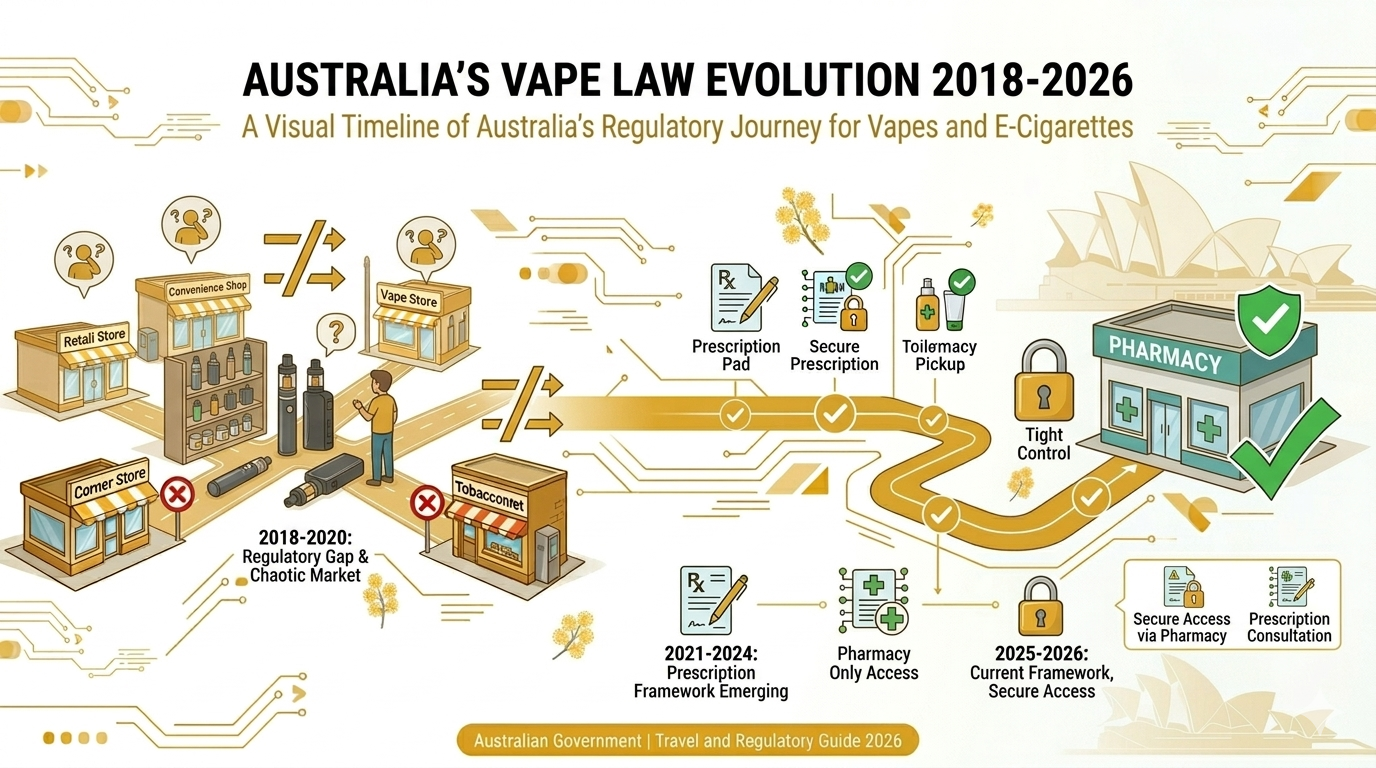
- The Foundation (Pre-2021): Nicotine was regulated as a controlled substance. Retail sale was banned, but personal importation with a doctor's prescription created a major loophole.
- The Pivot (2021): The decisive shift: nicotine for vaping became a prescription-only medicine, establishing vaping as a therapeutic good. This was the first major step in Australia vape laws evolution.
- The Crackdown (2024): Responding to youth usage, the government reset the supply chain with phased import bans and made it illegal to sell vapes outside pharmacy settings.
- The Tightening (2025): Product standards were strengthened to further restrict flavours, nicotine strength, and ingredients in legal products.
- The Logic: The policy aims to prevent recreational vaping normalization through a strict medical framework and aggressive illicit supply chain targeting.
Introduction: The Driving Forces Behind Australia's Vape Policy Evolution
Australia's path to enacting some of the world's most restrictive vaping regulations represents a calculated response to evolving public health challenges, not a sudden reaction. The period from 2018 to 2026 saw policymakers systematically address three critical issues: the alarming rise in youth uptake, the explosive growth of an illicit market that easily circumvented early regulations, and a foundational commitment to a strictly therapeutic access model. This historical analysis traces the logical progression of Australia vape laws evolution that transformed nicotine vaping from an accessible consumer product into a tightly controlled prescription medicine. Understanding this Australia vape laws evolution is essential for every Australian vaper.
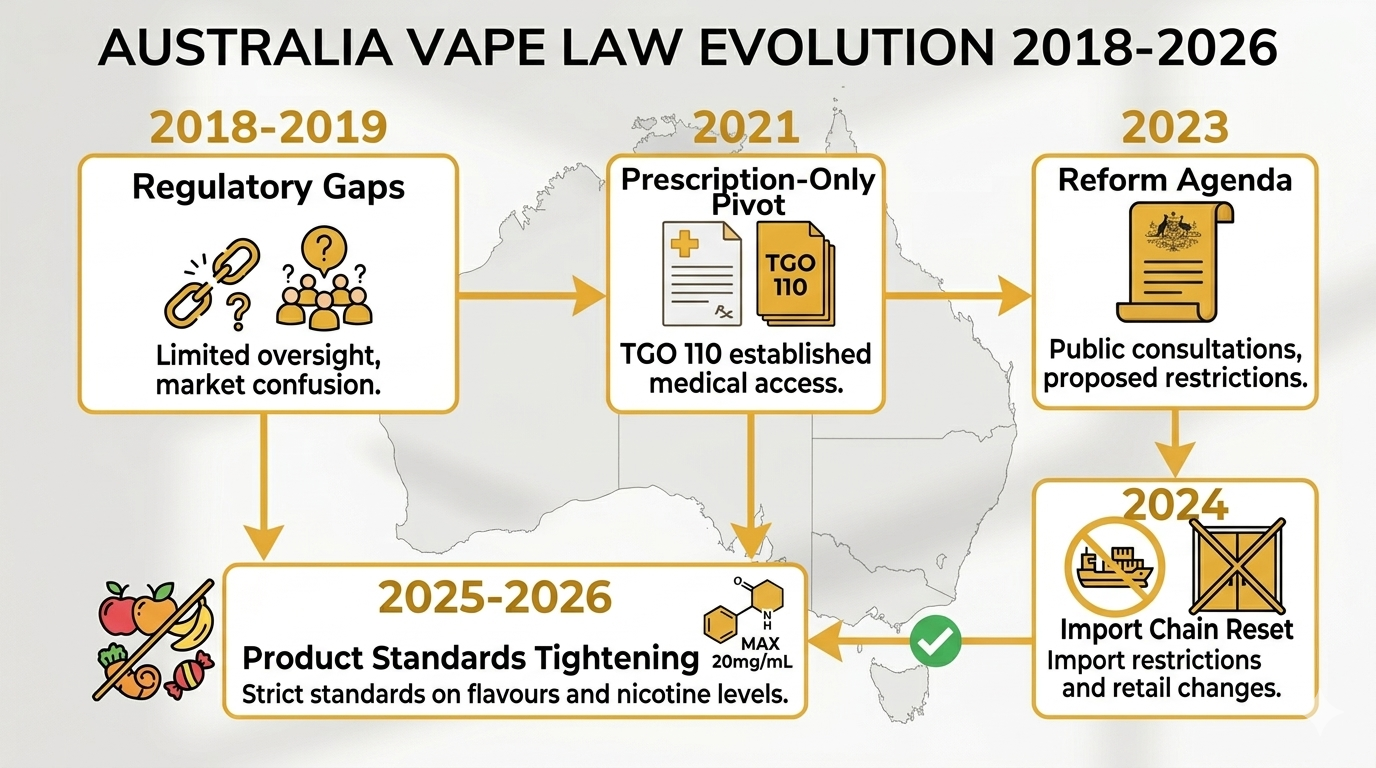
Regulatory Gaps: Limited oversight, market confusion, personal import loophole. The early phase of Australia vape laws evolution was marked by chaos.
Prescription-Only Pivot: Nicotine rescheduled to S4, TGO 110 established medical access. This was the turning point in Australia vape laws evolution.
Reform Agenda: Public consultations, proposed restrictions announced.
Supply Chain Reset: Import bans on disposables, retail ban outside pharmacies. This phase of Australia vape laws evolution directly targeted illicit retail.
Product Standards Tightening: Strict limits on flavours and nicotine levels, completing the Australia vape laws evolution journey.
2018–2019: The Early Landscape – Regulatory Gaps and Market Chaos
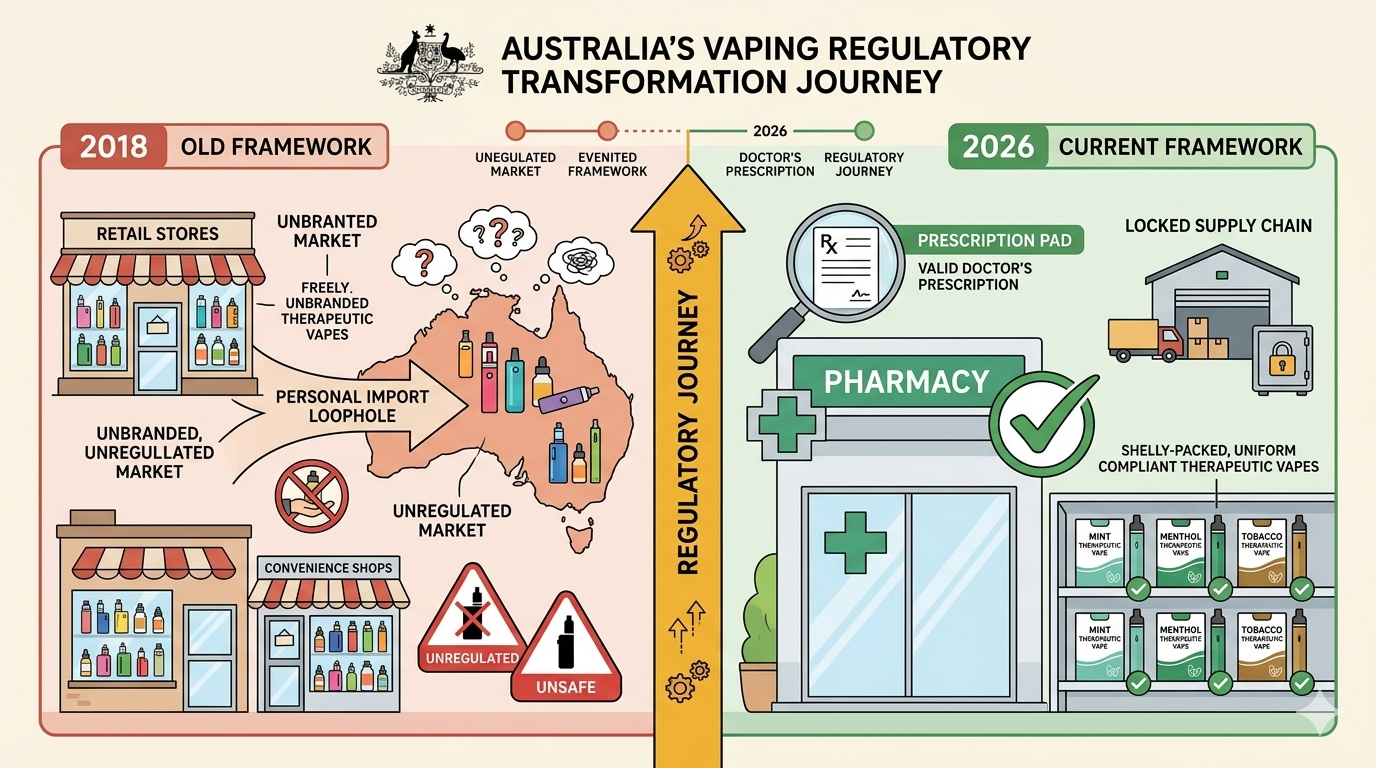
Prior to major federal intervention, Australia's regulatory framework was anchored by an older classification: nicotine (outside of tobacco) as a Schedule 7 (Dangerous Poison), which prohibited its retail sale. However, a significant policy gap existed via the Personal Importation Scheme, allowing adults to legally import up to a three-month supply for personal use with a doctor's prescription. This early period of Australia vape laws evolution was characterized by confusion and inconsistent enforcement.
This system proved ineffective and created a paradoxical market. While a prescription was technically required for nicotine, enforcement was minimal and public awareness low. A vast, visible market of often mislabeled nicotine-free devices flourished in convenience stores, tobacconists, and online. This widespread availability, coupled with inconsistent state-level enforcement, resulted in a chaotic environment where the law was clear in statute but muddled in practice, creating a clear imperative for comprehensive reform.
2020–2021: The Prescription-Only Pivot – Medicalizing Access
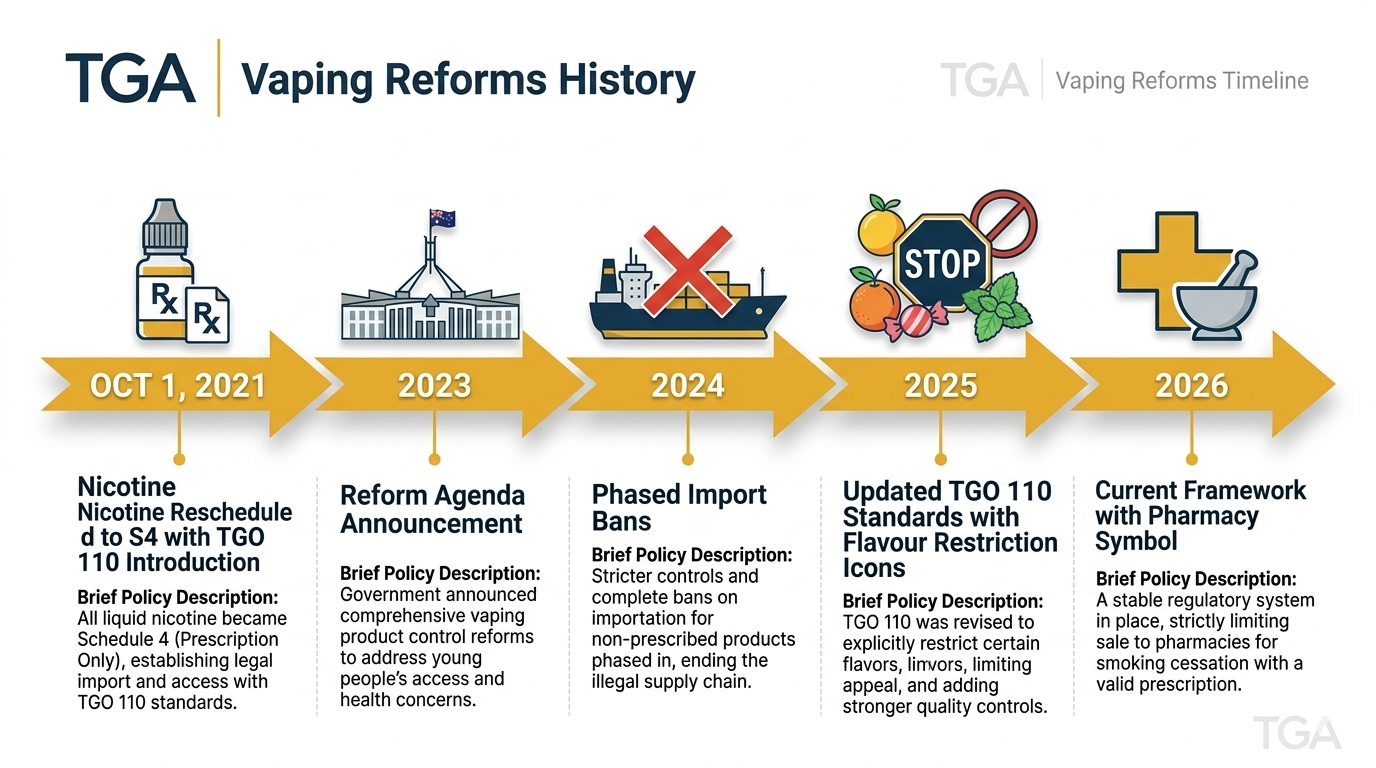
This period marked the first major inflection point in Australia vape law history. Motivated by increasing use and specific safety incidents, authorities moved decisively to medicalize access entirely. The 2021 prescription pivot was a turning point in Australia vape laws evolution, shifting from retail availability to medicalized access.
The key changes implemented from October 1, 2021, were:
- Rescheduling of Nicotine: From Schedule 7 (Dangerous Poison) to Schedule 4 (Prescription Only Medicine).
- Introduction of TGO 110: The first set of mandatory product standards covering ingredients, nicotine concentration limits, child-resistant packaging, and health warnings.
The government's intent was unambiguous: to establish nicotine vaping solely as a smoking cessation tool under medical supervision. However, the illicit market adapted rapidly, flooding the country with non-compliant, disposable products that were often flavoured and marketed in ways that appealed to youth. This blatant circumvention of the new rules directly led to the next, more aggressive phase of Australia vape laws evolution.
2023: The Reform Agenda Is Signaled – A Shift to Supply Chain Control
By 2023, mounting data revealed the prescription model alone was insufficient to curb rapidly rising youth usage. In response, the government announced a comprehensive policy reset, publicly framing vaping as a threat creating a new generation of nicotine dependency. This announcement signaled the next phase of Australia vape laws evolution.
The announced strategy represented a fundamental tactical shift. The focus moved beyond regulating the end-user (via prescriptions) to actively dismantling the commercial supply chain. The plan was explicitly staged: first halt the flow of illegal products at the border, then shut down domestic retail distribution channels. This public announcement marked the official transition from a policy centered on medical access to one preparing for full-scale enforcement against the commercial entities supplying the vaping market.
2024: The Supply Chain Reset – Enforcement at Scale
Throughout 2024, the signaled reforms were implemented through a series of rolling commencement dates, representing the most significant practical crackdown on the vaping market to date. The 2024 supply chain reset marked a critical phase in Australia vape laws evolution, directly targeting illicit retail channels.
The strategy unfolded in two clear, sequential prongs:
- Border Control: Bans were placed first on the import of disposable vapes, then expanded to all non-therapeutic vaping products. This aimed to turn off the tap of illicit goods.
- Domestic Retail Ban: The sale of any vaping product outside of a pharmacy setting became illegal nationwide, targeting convenience stores, tobacconists, and vape shops.
2025: Product Standards Tightened – Constricting the Legal Market
Operating in parallel with the supply chain crackdown, the government further tightened the specifications for any product that could be legally supplied. Updated Therapeutic Goods (Standard for Nicotine Vaping Products) (TGO 110) Order standards came into full effect, continuing the Australia vape laws evolution toward stricter control.
These enhanced standards further restricted the legal product market by lowering maximum permitted nicotine concentrations, further limiting permissible ingredients and flavours to minimize appeal, and mandating specific pharmaceutical-style packaging and disclosure requirements.
The dual-pronged regulatory approach became clear: make the illicit supply of non-compliant products a high-risk activity through aggressive enforcement, while simultaneously making the legal, therapeutic product as unattractive as possible for non-medical or recreational use.
2026: The Current Framework – Pharmacy-Centric & Supply-Focused
By 2026, the cumulative effect of these sequential changes has solidified a unique and rigorous regulatory framework. Nicotine vaping is now firmly entrenched within a pharmacy-based, therapeutic goods system, completing the Australia vape laws evolution journey. The overarching policy intent remains to deny the existence of a consumer market for recreational vaping. To understand the current rules in detail, read our Australia Vape Laws 2026: What's Legal and What's Not and Where to Buy Vapes Legally in Australia (2026 Pharmacy Guide).
The contemporary enforcement focus, as communicated by regulatory agencies, remains squarely on disrupting the illicit trade. The underlying policy logic acknowledges that a black market may persist but aims to constrict its size, reach, and accessibility by ensuring legal supply is purely medical and making illegal supply a high-risk enterprise for commercial operators.
Conclusion: From Consumer Product to Therapeutic Good – A Story of Progressive Enclosure
The history of Australian vape laws is ultimately a story of progressive regulatory enclosure. Policy evolved from a set of confusing and easily exploited rules into a coherent, if exceptionally strict, system driven by a singular objective: to prevent vaping from becoming a normalized consumer behavior. Understanding Australia vape laws evolution helps explain why today's framework is so strict.
Each phase of policy development—initial restriction, medicalization, supply chain enforcement, and product standard tightening—was a direct response to the perceived failures and market adaptations of the preceding phase. Throughout this Australia vape laws evolution, the core drivers remained constant: the protection of youth, the primacy of the therapeutic model over recreational use, and an increasing willingness to employ aggressive regulatory tools to control the entire supply chain. The result is a policy environment that seeks to dictate not merely how a product can be used, but if and through what exclusive channels it can be legally supplied at all.
🇦🇺 G'DayVape perspective: Understanding the Australia vape laws evolution from 2018-2026 helps explain today's strict framework. We are committed to full compliance and providing accurate information to help adult vapers navigate the current legal landscape.
📚 Official References & Authoritative Sources
- Therapeutic Goods Administration (TGA). Vaping reforms to protect Australians. Australian Government Department of Health. tga.gov.au
- Australian Government Department of Health and Aged Care. Media release: Vaping Reforms to Protect Australians. health.gov.au
- Department of Health and Aged Care – Vaping Hub. Vaping in Australia. health.gov.au
- Australian Border Force (ABF). Tobacco and Vaping Products Import Controls. abf.gov.au
- Therapeutic Goods Administration (TGA). Regulation of Nicotine Vaping Products. tga.gov.au
All external sources are Australian government or official health institutions. Links are dofollow and open in new tabs. Information current as of March 2026.
© 2026 G'DayVape — Australian vape knowledge, grounded in clarity. Always adult-only. This guide is for informational purposes only and does not constitute legal advice. Always verify current regulations with official government sources.
 RELX Pod