

Blog
Vape Battery Recycling: How to Dispose of Lithium-Ion Batteries Safely (2026)

Why Vape Batteries Cannot Go in Household Bins
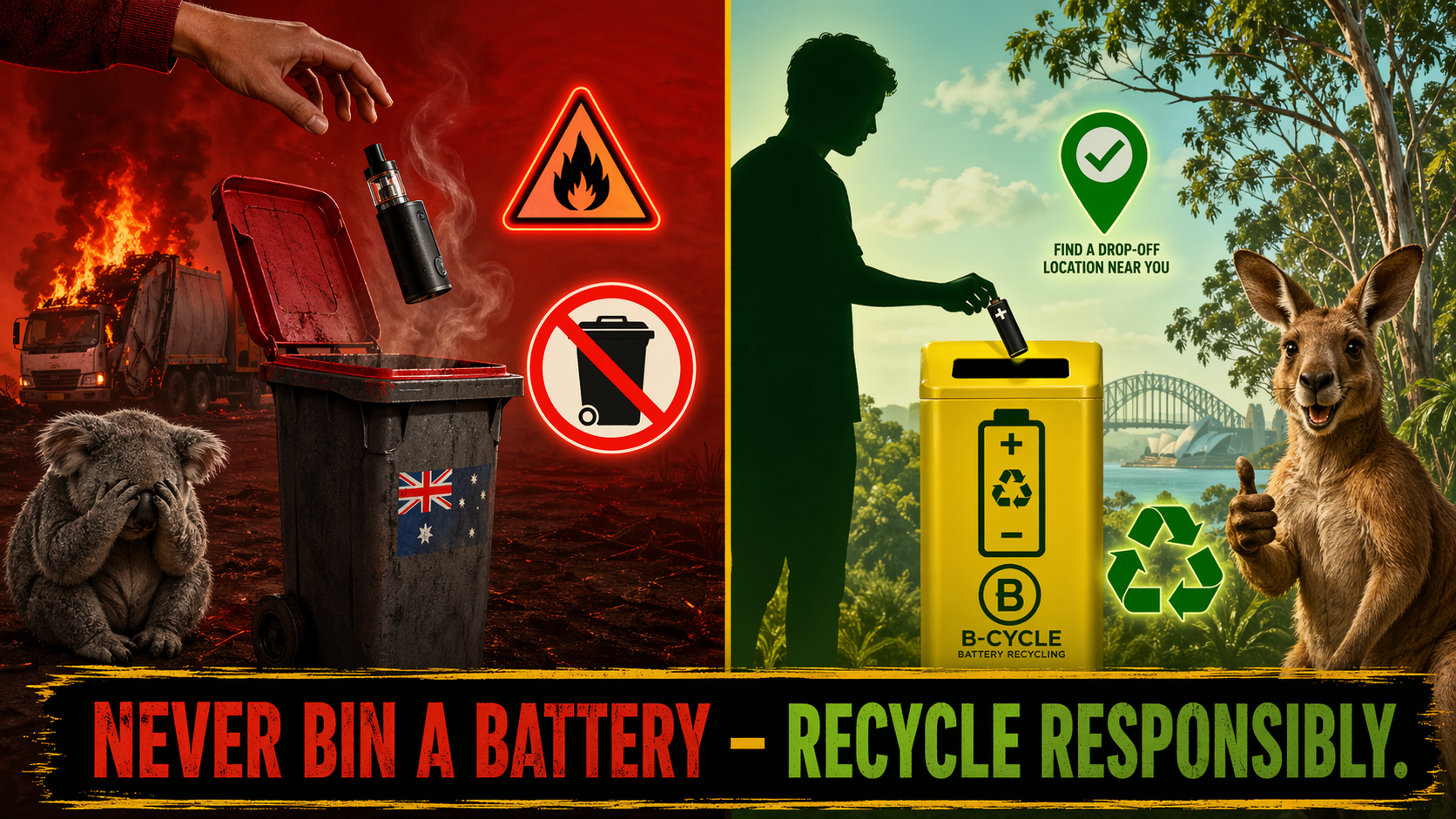
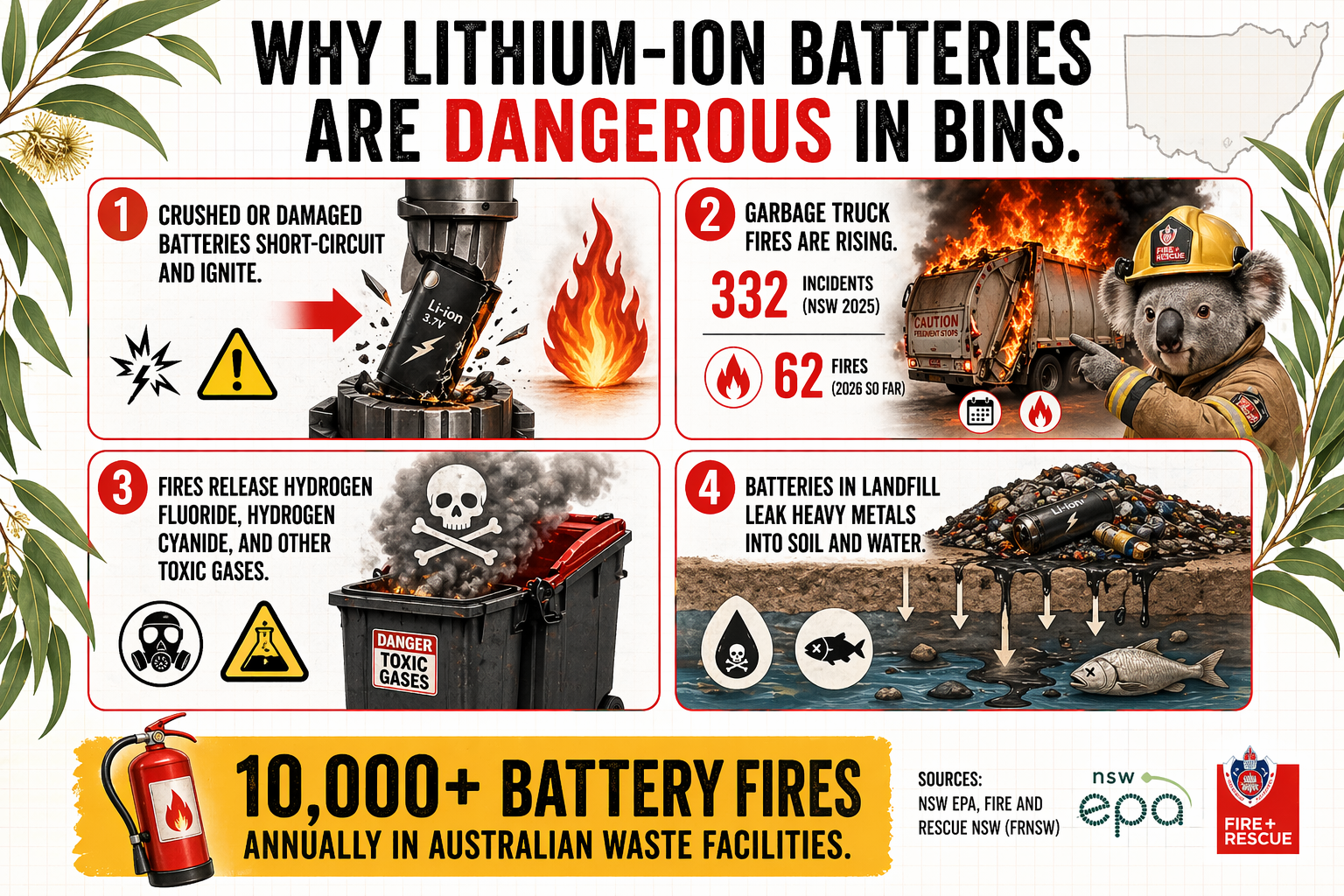
Every vape device—whether a disposable, a pod system, or a rechargeable mod—contains a lithium-ion battery. These batteries are highly energy dense, but they pose a serious fire hazard when crushed or damaged, such as when compacted in garbage trucks or at transfer stations[reference:0].
When a lithium-ion battery is crushed, overheated, or damaged, it can enter a state called thermal runaway—a chemical chain reaction where the battery rapidly releases stored energy, generating flammable gases and intense heat, often causing a fire or explosion. These fires burn hotter than ordinary rubbish fires and are extremely difficult to extinguish[reference:1][reference:2].
The Scale of the Problem
- 332 incidents recorded by Fire and Rescue NSW in 2025 involving lithium-ion batteries—nearly one a day[reference:3].
- 62 battery fires in the community and at least 12 in garbage trucks and waste facilities so far in 2026[reference:4].
- Over 10,000 battery fires in waste collection trucks and facilities across Australia every year[reference:5].
- Fire Rescue Victoria is responding to almost one fire per day caused by lithium-ion batteries—and the trend is forecast to worsen[reference:6].
Environmental Impact of Improper Disposal
Beyond the immediate fire risk, discarded batteries in landfill leach toxic heavy metals—including cobalt, nickel, manganese, and lithium—into soil and groundwater. These contaminants can persist in the environment for decades and harm ecosystems and human health[reference:7].
Australia currently recycles only about 10% of lithium-ion battery waste—compared to 99% of lead-acid battery waste. The CSIRO notes that there is little capacity in Australia for processing lithium-ion batteries, and large volumes are stored in warehouses and scrap yards, creating additional fire risks and environmental contamination[reference:8].
By 2035, Australia is projected to generate 137,000 tonnes of lithium battery waste annually[reference:9]. Recycling these batteries significantly reduces environmental harm—recycling emits up to 61% less carbon, uses 83% less energy, and consumes 79% less water compared to mining virgin materials[reference:10].
Where to Recycle Your Vape Battery or Device
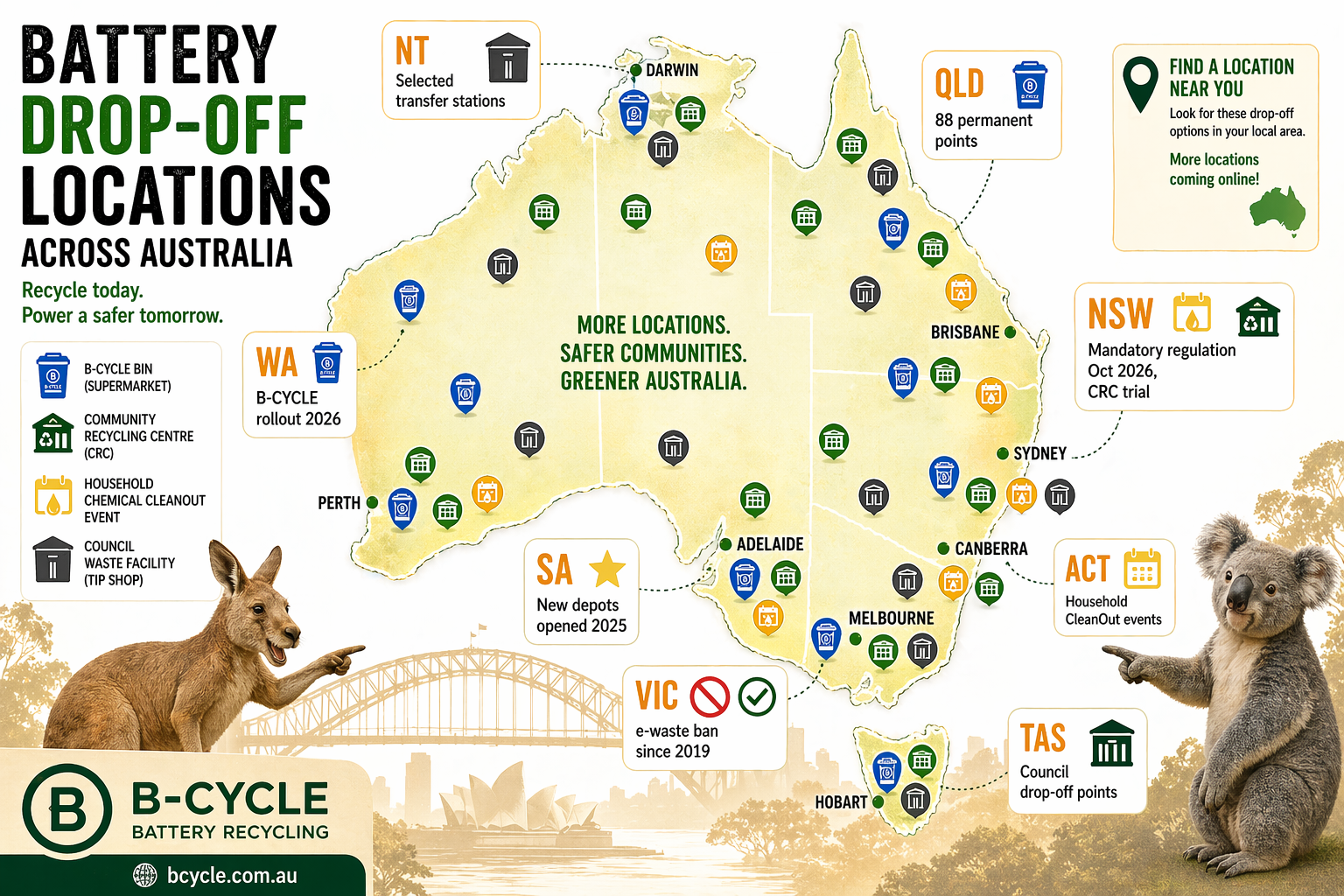
Australia has multiple free drop-off options for vapes and batteries. Never attempt to remove the battery from a sealed device yourself—take the whole device to a collection point[reference:11].
State-Specific Collection Programs
Queensland
The Queensland Government's $2 million Local Government Battery Collection Program is funding 88 permanent battery collection points, three mobile collection services, and 28 temporary pop-up locations. The program specifically targets lithium-ion batteries found in vapes, e-scooters, laptops, phones, power tools, children's toys, and common household items like electric toothbrushes and cordless vacuums[reference:18].
The North Queensland Regional Organisation of Councils (NQROC) is also running an embedded battery collection program until 15 November 2026, accepting vapes and other embedded battery devices for free at participating waste facilities[reference:19].
New South Wales
NSW has passed mandatory battery regulation—the first state in Australia to do so. The regulation requires battery brand owners to fund safe collection and recycling, with penalties of up to $880,000 for non‑compliance. The regulation is expected to commence on 1 October 2026[reference:20][reference:21].
The EPA's "Never Bin a Battery" campaign encourages households to use free drop‑off points. Fire trucks in high-risk areas now carry campaign decals to raise awareness[reference:22]. Vapes are accepted at Household Chemical CleanOut events and select CRCs[reference:23].
Victoria
Victoria banned all e‑waste from landfill as of 1 July 2019. E‑waste—including vapes—cannot go in any household bin. Free drop‑off points are available at council transfer stations and through the B-cycle network[reference:24]. Several councils, including Hume City Council, have partnered with Eco‑batt to provide dedicated vape disposal bins at libraries and community centres[reference:25].
South Australia
South Australia has expanded embedded battery disposal depots, with new locations at North Plympton, Heathfield, Campbelltown, and Edinburgh North. The service accepts products with embedded batteries, including vapes, for free disposal[reference:26].
How to Handle a Damaged or Swollen Vape Battery
If you notice your vape device is swollen, bulging, leaking, or unusually hot, handle it with extreme care. A damaged battery can ignite or explode without warning.
- ⚠️ Do not charge or use the device. A damaged battery is unsafe to operate under any circumstances.
- Do not puncture or crush the battery. This can trigger immediate thermal runaway.
- Do not place in household bins. Damaged batteries are even more hazardous than intact ones.
- Place in a non‑flammable container. Use a metal tin, glass jar, or ceramic bowl away from flammable materials.
- Store in a cool, dry place away from combustibles. Keep the container in a garage or outdoors, not in living areas.
- Contact your local council or waste facility. Ask if they accept damaged batteries. Some facilities have specialised handling procedures.
- Do not transport in your pocket. If you must transport the device, place it in a rigid, non‑conductive container with taped terminals.
What Happens to Recycled Vape Batteries?
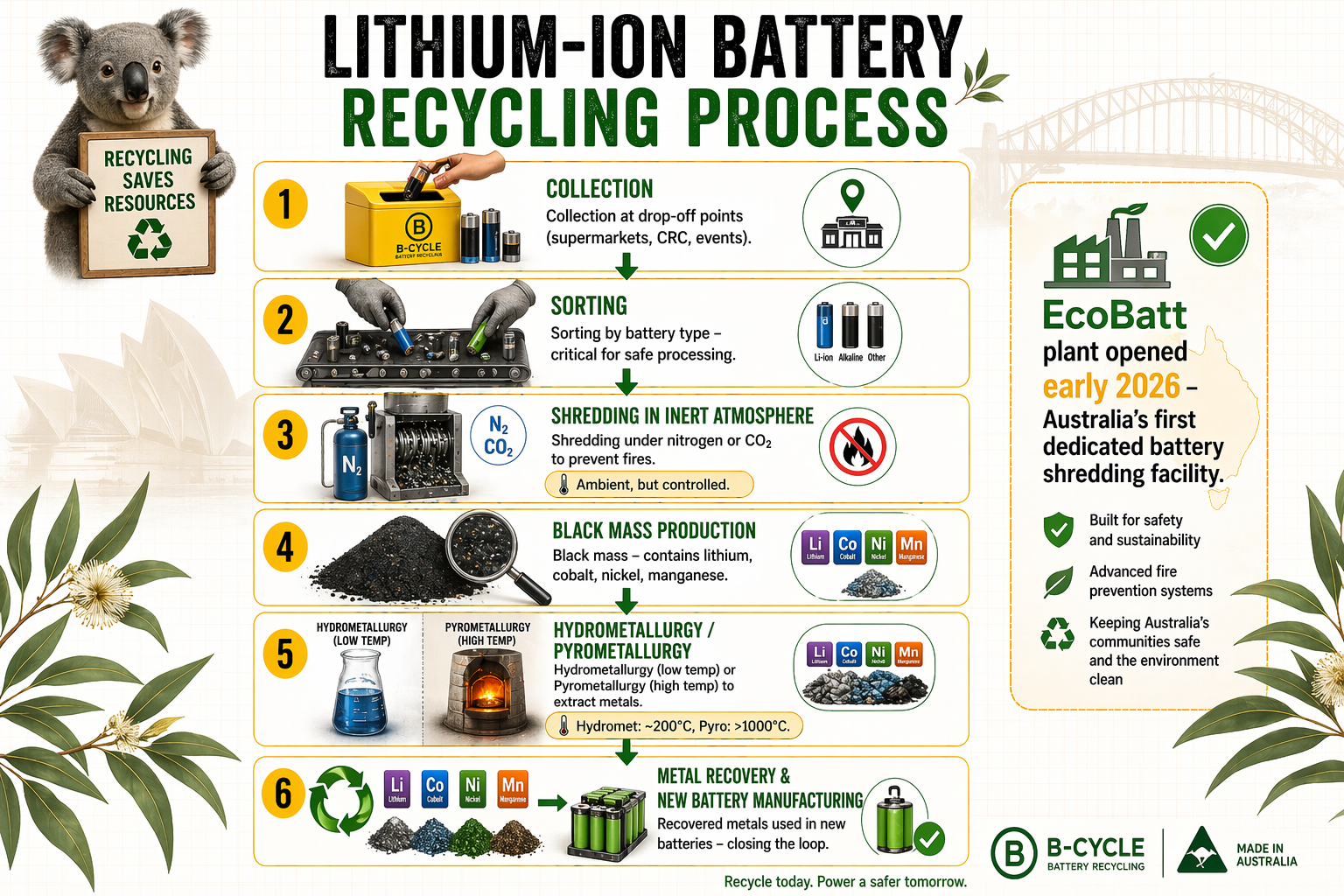
Once collected, vapes and batteries are processed by specialised recycling facilities. The typical recycling process includes:
- Sorting and dismantling: Devices are sorted by battery type. For vapes, the whole device is processed without manual battery removal—a safer approach that reduces worker exposure to hazardous materials.
- Shredding and mechanical separation: Batteries are shredded in an inert atmosphere (often using nitrogen or carbon dioxide) to prevent fires. The resulting material—known as "black mass"—contains valuable metals like lithium, cobalt, nickel, and manganese[reference:27].
- Hydrometallurgical or pyrometallurgical processing: Black mass is processed to extract individual metals. Hydrometallurgy uses chemical leaching, while pyrometallurgy uses high‑temperature smelting (over 1,000°C). Both methods have environmental trade‑offs, and researchers are developing greener alternatives such as mechanical activation technology[reference:28].
- Material recovery: Recovered metals are sold back into manufacturing supply chains to produce new batteries, reducing the need for environmentally destructive mining.
Australia currently lacks large‑scale lithium battery recycling capacity. Most black mass is exported overseas for processing. However, new facilities are emerging—EcoBatt (part of the EcoCycle Group) opened a dedicated lithium battery shredding plant in early 2026, representing a step toward domestic recycling infrastructure[reference:29].
Upcoming Regulations: 2026 and Beyond
Governments at both state and federal levels are taking action to address the battery waste crisis.
A $50 million national battery collection network has been proposed, with funding to fill gaps in accessible disposal points and keep batteries out of waste streams. Components would start from 1 July 2026[reference:30].
Under proposed federal reforms, brand owners would be required to fully fund safe collection and recycling for all consumer electronics and battery‑containing products, including vapes[reference:31].
NSW will be the first state to implement mandatory battery regulation, commencing 1 October 2026. Battery suppliers who fail to comply face penalties up to $880,000[reference:32].
Quick Reference: What Goes Where
Frequently Asked Questions
Can I throw a disposable vape in the general waste bin?
No. Disposable vapes contain a lithium‑ion battery and a heating element, both of which are hazardous. They must be disposed of at designated drop‑off points. Placing them in household bins creates a serious fire risk[reference:33].
Can I remove the battery from my vape before disposing of it?
No. Do not attempt to remove embedded batteries yourself—this can damage the battery and cause a fire. Take the whole device to a collection point[reference:34].
Is there a cost for vape battery recycling?
Most drop‑off points are free for households. Council waste facilities, B-cycle bins, and CRC services do not charge residents for battery recycling[reference:35].
What if my local council doesn't have a drop‑off point?
Use online tools like Recycle Mate (recyclemate.com.au) or Planet Ark (recyclingnearyou.com.au) to find the nearest collection point. Many retailers (Coles, Woolworths, Bunnings) accept batteries regardless of council services[reference:36].
What happens if I put a vape in my household bin?
If detected, your bin may not be collected. More importantly, the vape can be crushed during collection or at the transfer station, potentially sparking a fire that endangers waste workers and damages equipment.
Product Recommendations
When you purchase a new device, consider its end‑of‑life impact. All products at G'DayVape are 100% authentic, but remember that even genuine devices require proper disposal at end of life.
🔄 RELX Pods – Replaceable, Not Refillable
🔄 RELX Devices – Long‑Lasting, Responsibly Made
🔞 Age verification required. Under Australian law, nicotine vaping products are therapeutic goods. Adults 18+ may purchase ≤20mg/mL from pharmacies without a prescription; higher strengths require a prescription.
🇦🇺 G'DayVape: We're committed to promoting responsible vaping practices, including proper disposal. All products are 100% authentic—but at end of life, always recycle through official channels.
📚 References & trusted sources
- NSW Environment Protection Authority (EPA) – Never bin a battery. epa.nsw.gov.au [Battery fire risks, B‑cycle scheme, embedded battery trial]
- NSW Government – NSW leads the country in battery reform to fight fires and pollution (April 2026). nsw.gov.au [332 lithium‑ion incidents in 2025, 62 fires in 2026 so far, mandatory battery regulation commencing 1 October 2026]
- Fire and Rescue NSW (via PV Magazine Australia) – Insurer flags rising home fire costs as lithium-ion battery incidents increase (August 2025). pv-magazine-australia.com [178 FRNSW incidents in 2025, thermal runaway, most incidents caused by user behaviour]
- Horsham Rural City Council – Council urges residents to keep batteries out of bins (May 2025). hrcc.vic.gov.au [Fire Rescue Victoria responding to almost one battery fire per day, lithium‑ion battery fire hazards]
- Queensland Government – Queensland powers ahead with Battery Collection Program (November 2025). statements.qld.gov.au [$2 million program, 88 permanent collection points, targets vapes and e‑scooters]
- Edith Cowan University / CSIRO (via Mining.com.au) – Recycling batteries for sustainable future (August 2025). mining.com.au [10% lithium‑ion battery recycling rate in Australia, 137,000 tonnes of waste by 2035]
- Australian Government Department of Industry, Science and Resources (via Batteries News) – Why recycling 'dead' batteries could save billions and slash pollution (August 2025). batteriesnews.com [137,000 tonnes lithium battery waste annually by 2035, recycling reduces carbon emissions by 61%, energy use by 83%, water use by 79%]
- B‑cycle – Australia's official battery recycling scheme. bcycle.com.au [Find drop‑off points for loose batteries]
- Sustainability Victoria – Recycle e‑waste. sustainability.vic.gov.au [E‑waste banned from Victorian landfill since 1 July 2019]
- Hume City Council – Vape disposal program (May 2025). hume.vic.gov.au [Eco‑batt partnership, dedicated vape bins at libraries]
© 2026 G'DayVape — Australian vape knowledge, grounded in clarity. Always adult-only.
 RELX Pod