

Blog
Are Rechargeable Disposable Vapes More Eco-Friendly? A Balanced 2026 Look

The Appeal of “Rechargeable Disposable”
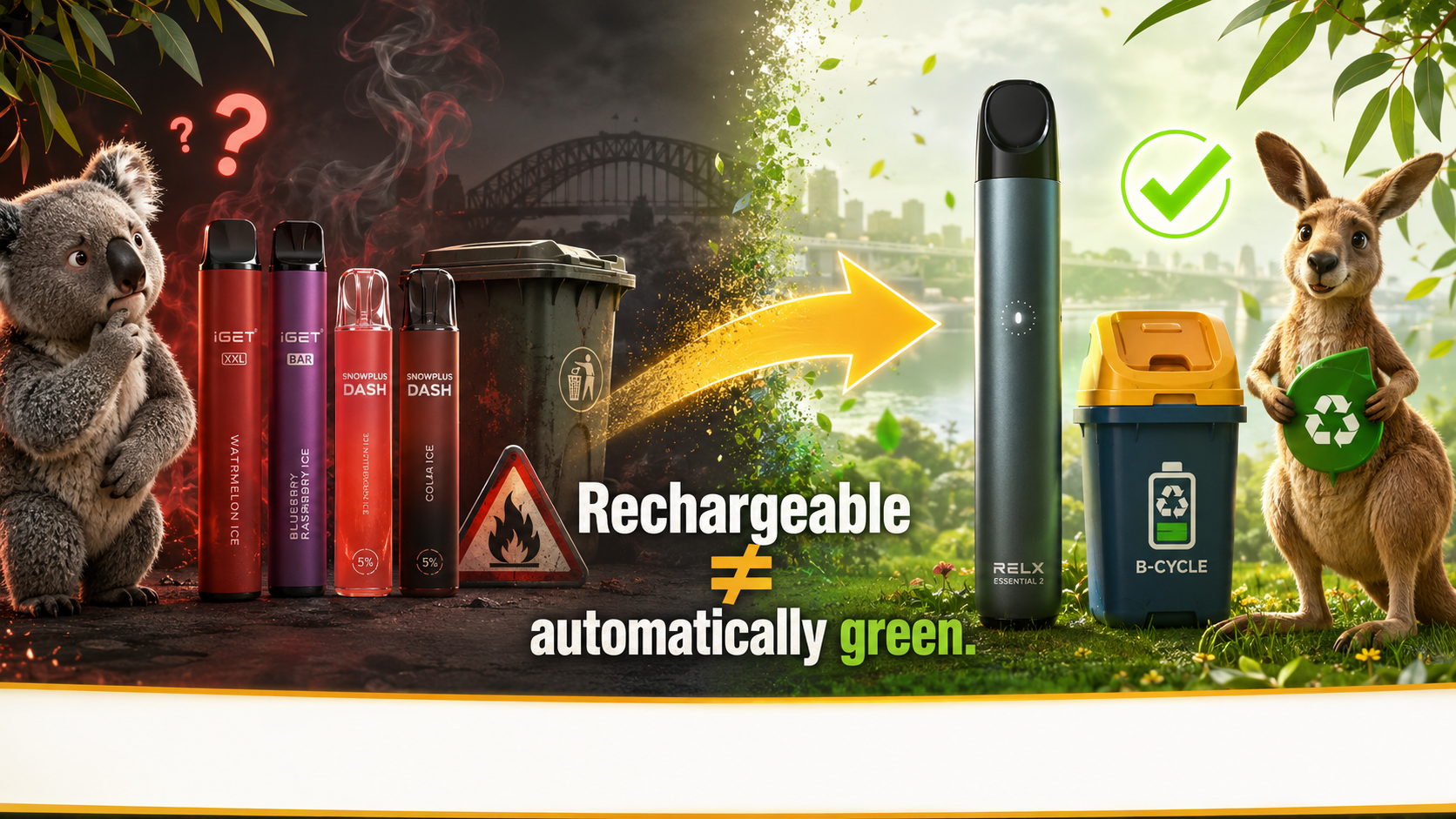
The concept seems intuitive: a disposable vape with a USB‑C port means you can use every drop of e‑liquid before tossing the device. That should be better, right? On the surface, yes. But the environmental question is more complex than battery‑life alone.
What Actually Makes a Vape “Eco‑Friendly”?
A genuinely low‑impact vape requires three things: dramatically fewer devices sent to landfill, high recycling rates for the waste that remains, and transparent product stewardship. Rechargeable disposables only address one of these issues—and not even fully.
One Million Devices a Week – AMA’s Wake‑Up Call
The AMA warns that vapes are an “environmental triple‑threat”: plastic waste (never fully degrades), electronic waste (batteries and circuit boards), and hazardous waste (heavy metals and nicotine). Plastic turns into microplastics; batteries corrode and leach metals; incorrectly discarded batteries cause daily fires. Swap a non‑rechargeable for a rechargeable and 90%+ of the same waste remains.
Carbon & Material Damage by the Numbers
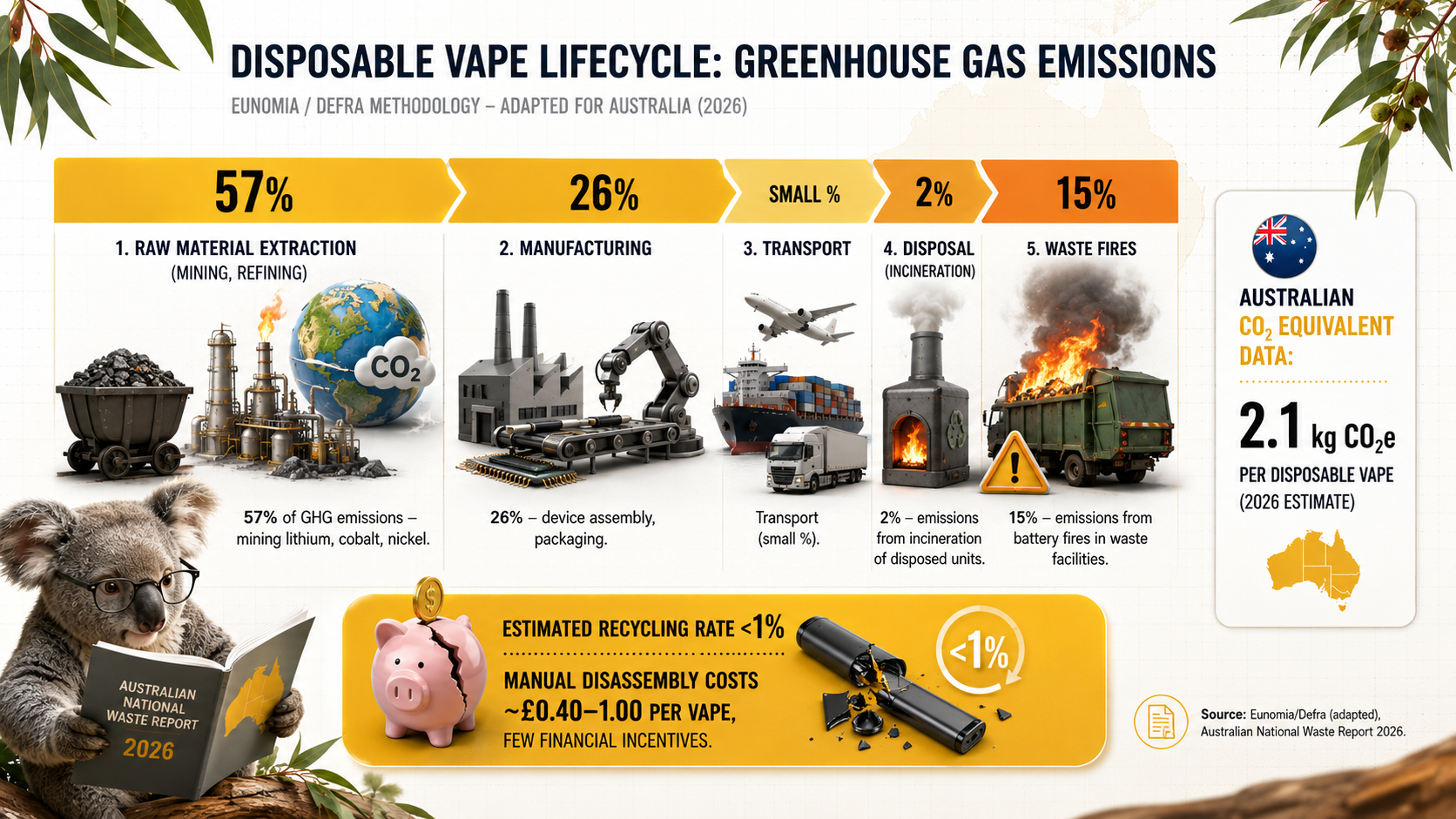
- 80,000 tonnes of CO₂e emitted in 2023 from single‑use vapes (UK data similarly applicable).
- 57% of emissions from raw material extraction (lithium, cobalt, copper, plastic).
- 15% of emissions from waste fires when lithium batteries ignite.
- Recycling rate ~1% – few vapes see dedicated facilities because dismantling is uneconomical.
Rechargeable disposables still contain lithium batteries, circuit boards, plastic shells and metal coils. Without behaviour change, the environmental impact remains almost identical.
The Australian Reality: Bans, Seizures & Illicit Flows
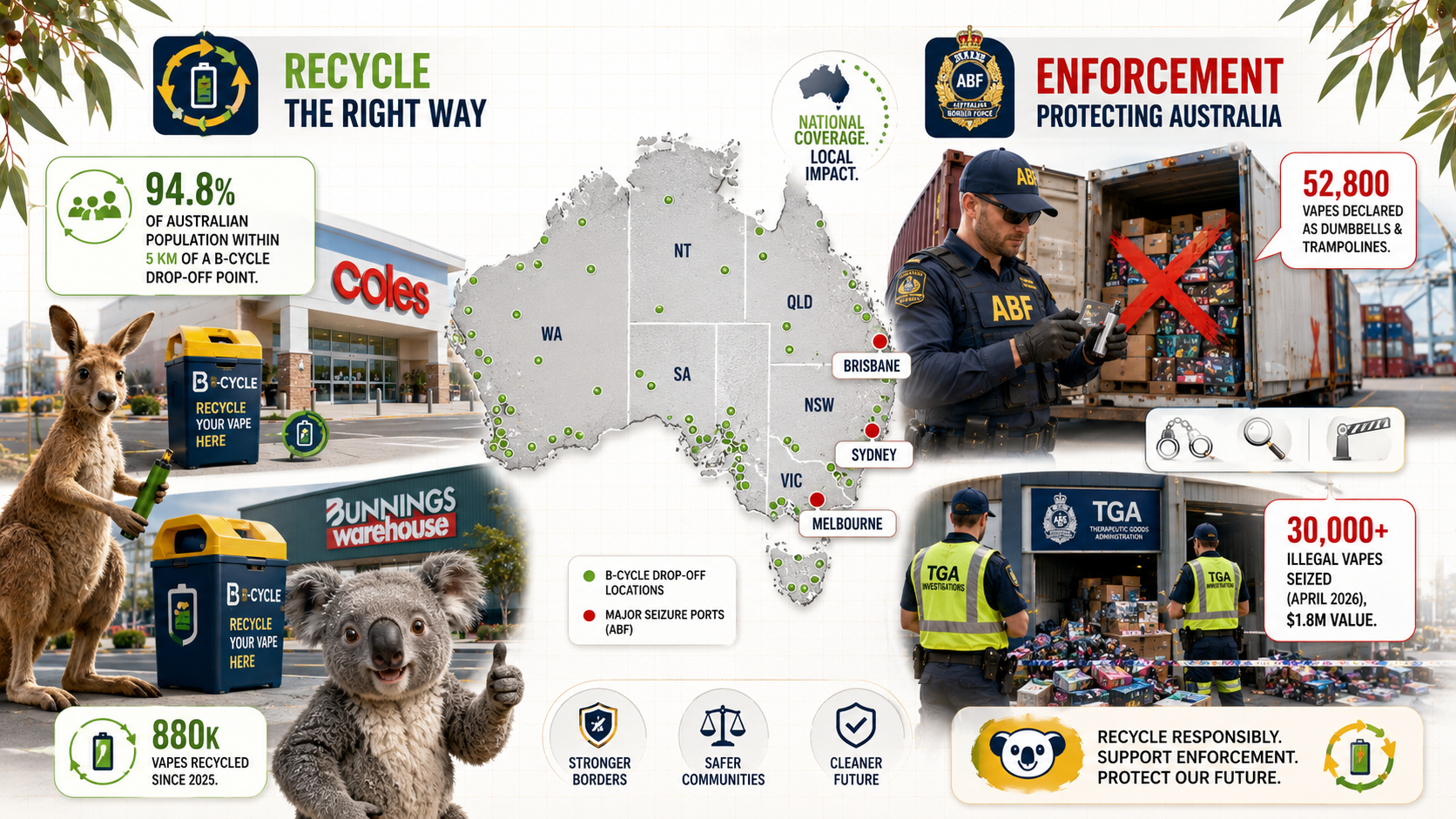
Disposable vapes (rechargeable or not) have been illegal to import since 1 Jan 2024. Yet authorities still intercept huge quantities: in April 2026, over 30,000 illegal devices were seized in Sydney (value $1.8 million). The ABF stopped $1 billion of evaded duty in a single quarter, including 52,800 vapes declared as “trampolines”.
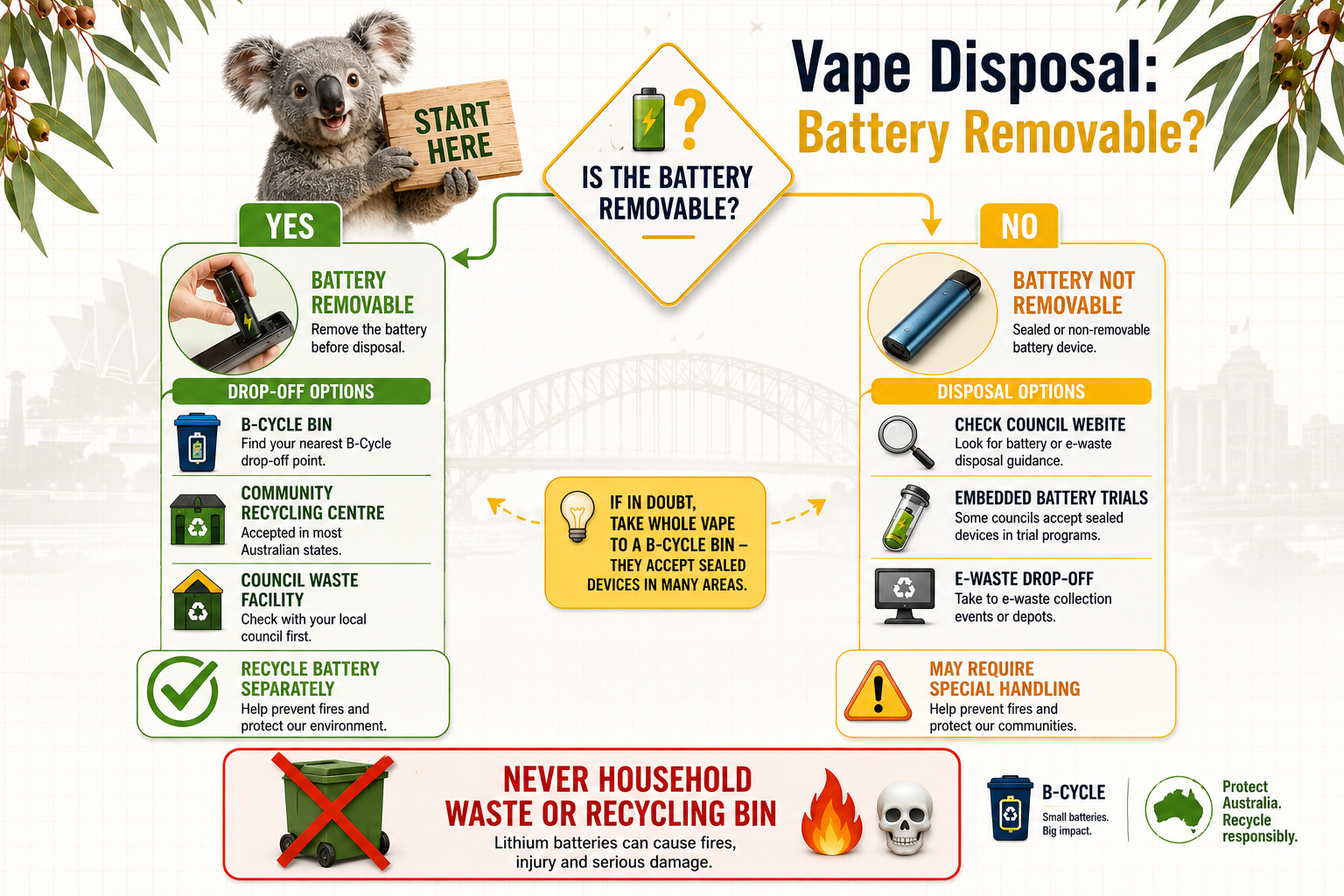
NSW has passed Australia’s first mandatory battery stewardship scheme (effective 1 Oct 2026), with penalties up to $880,000 for non‑compliance – highlighting the urgent need for better recycling.
Rechargeable vs Disposable vs Refillable Kit
| Factor | Traditional Disposable | Rechargeable Disposable | Refillable Pod Kit |
|---|---|---|---|
| Battery discarded | ✅ every device | ✅ every device | ❌ once per 1‑2 years |
| Plastic + circuit board | ✅ every use | ✅ every use | ❌ only the device (rarely) |
| E‑waste per month | 10–30 devices | 10–30 devices | 0 devices (only replace pods) |
| Pod/coil waste | integrated | integrated | small pod (recyclable where accepted) |
| Compatible with B‑Cycle | ❌ | ❌ | ✅ |
What Australian Vapers Can Do Right Now
- Switch to a RELX reusable device. One battery for 12+ months – far less e‑waste.
- Buy pods in bulk (10‑pack). Fewer shipments, less packaging, lower emissions.
- Use B‑Cycle drop‑offs. 94.8% of Australians live within 15 minutes of a drop‑off point.
- Follow TGA rules. Legal therapeutic vapes avoid feeding the black‑market waste chain.
🔄 RELX Devices – One Device for 1‑2 Years
🔄 RELX Pods – Only the Pod is Replaced
🔞 Age verification required. Under Australian law, adults 18+ may purchase ≤20mg/mL from pharmacies without a prescription; higher strengths require a prescription.
🇦🇺 G'DayVape: We support responsible vaping and encourage all adult users to recycle through official battery stewardship schemes. All products are 100% authentic.
© 2026 G'DayVape — Australian vape knowledge, grounded in clarity. Always adult-only.
 RELX Pod