
Blog
Australia Vape Laws 2018-2026: Full Regulatory Timeline

The Big Picture: 2018 vs 2026
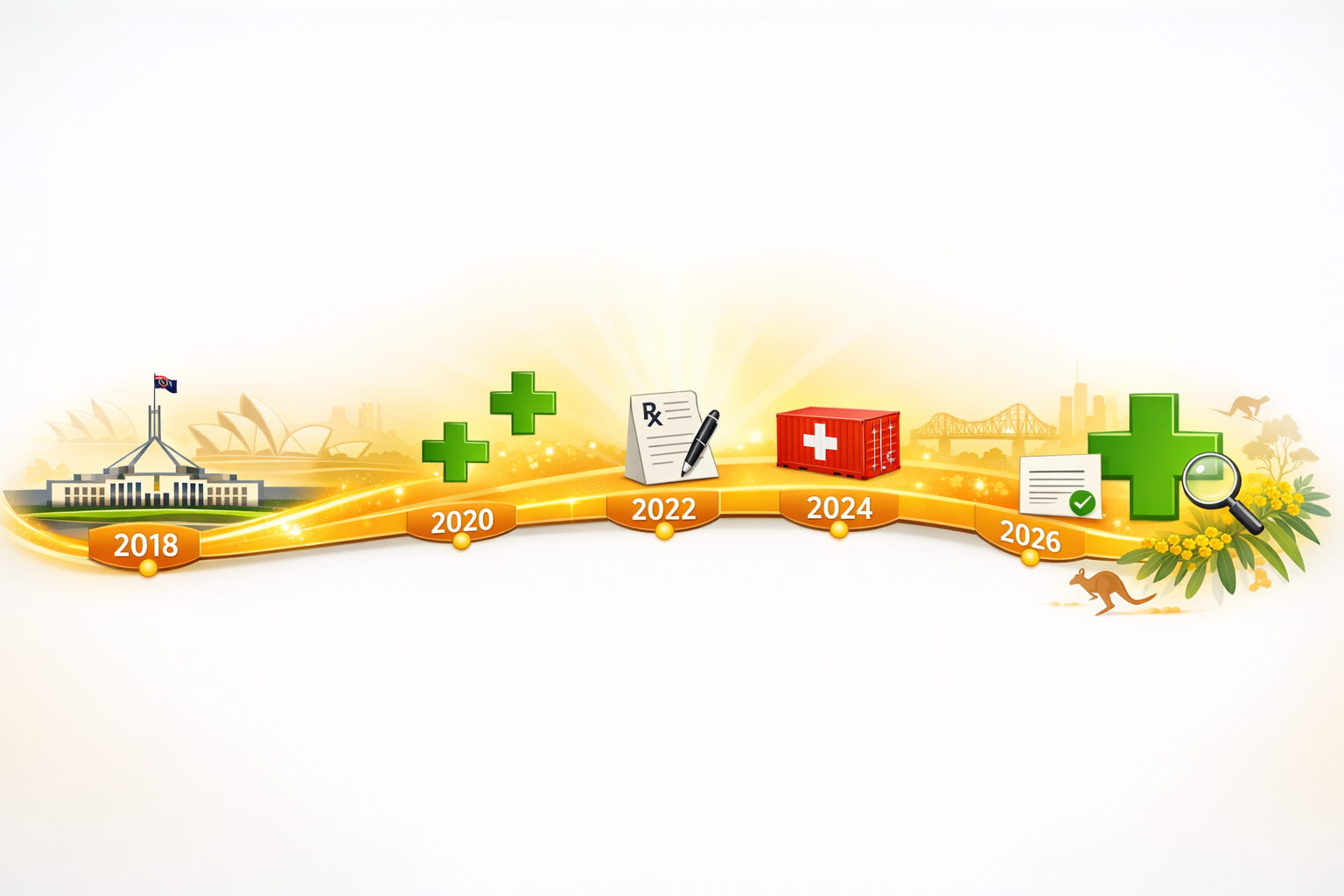
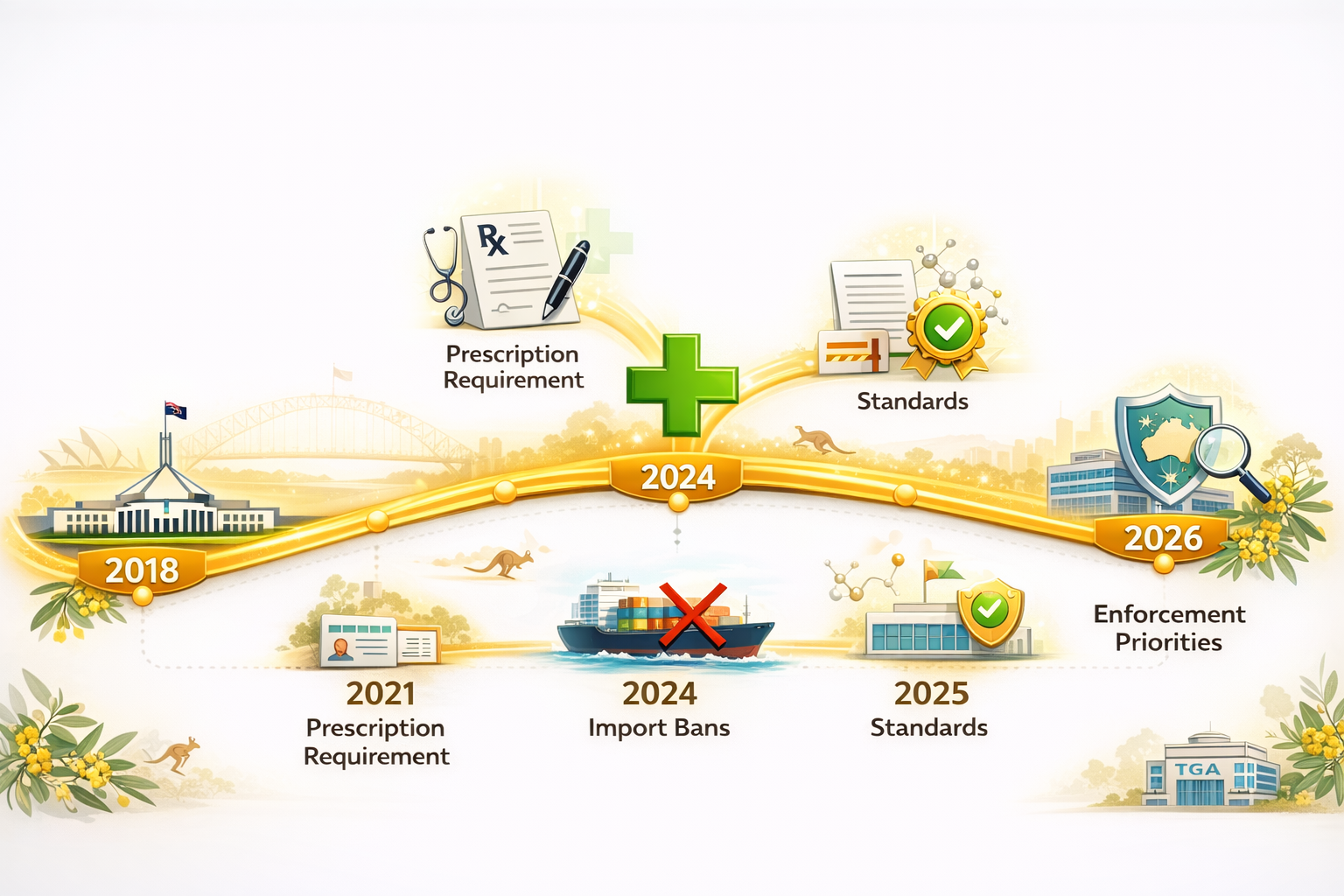
Australia's vaping regulatory journey reflects a deliberate shift from treating vapes as consumer goods to regulating them as therapeutic products [8]. What began as patchwork state rules and personal import allowances has become a tightly controlled national system focused on public health and youth protection.
Fragmented Era
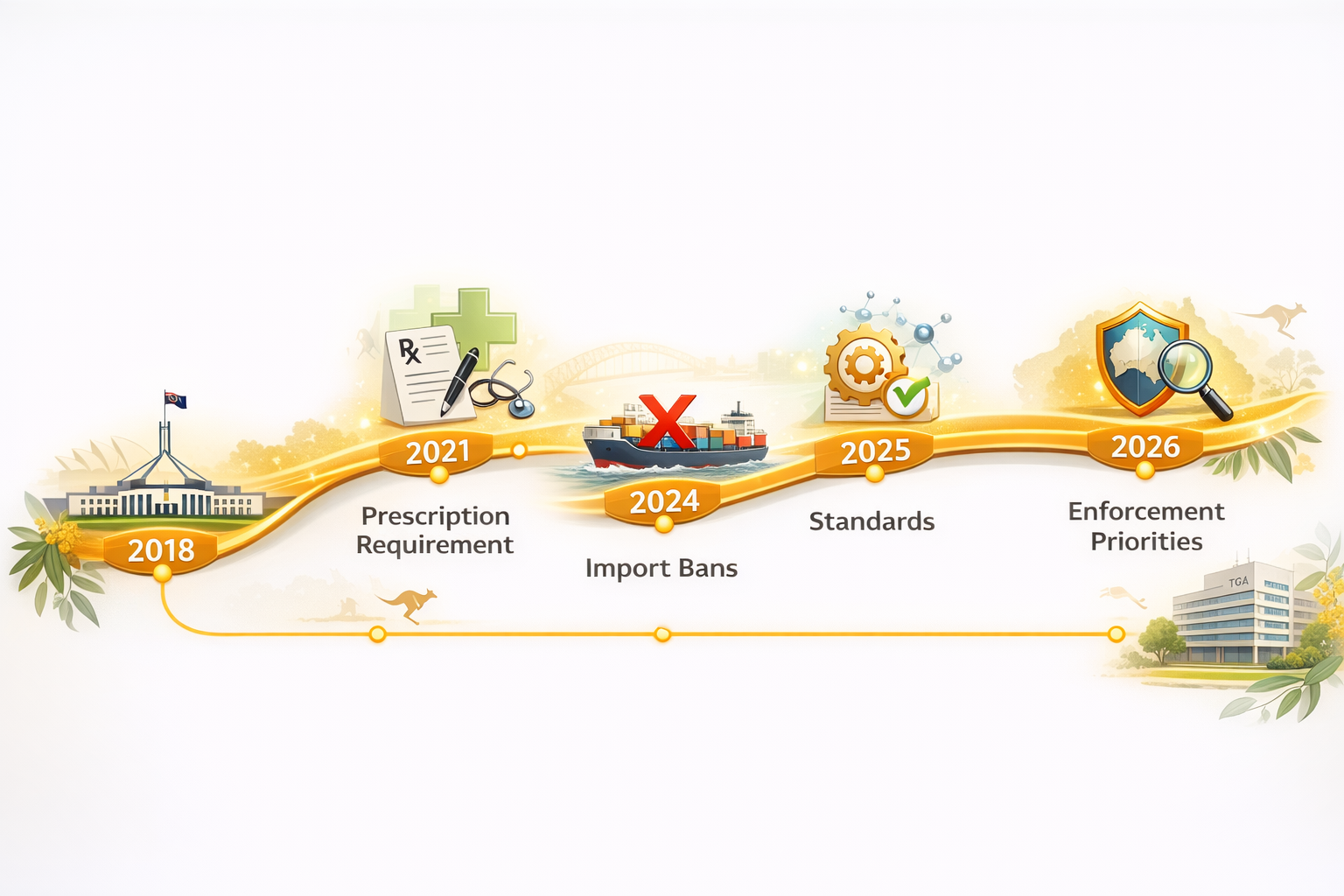
Nicotine treated as poison (Schedule 7). Personal import allowed with prescription. Non-nicotine vapes sold in retail under varying state laws [8].
Prescription Mandate
Nicotine rescheduled to Schedule 4 (prescription only). TGO110 introduces product standards: child-resistant packaging, ingredient lists, warning labels [8].
Import Bans & Pharmacy Model
1 Jan: disposable import ban. 1 Mar: all non-therapeutic vapes banned from import. 1 Jul: retail sale limited to pharmacies only [8].
1. Access Pathways: From General Retail to Pharmacy-Only
Prior to 2021, nicotine-containing vapes could be imported personally with a prescription, while non-nicotine devices were sold in specialty shops and convenience stores under inconsistent state rules [8]. The 2024 reforms fundamentally changed this: since 1 July 2024, all vaping products—nicotine and non-nicotine—can only be lawfully sold in pharmacies [6][8].
Current access rules (as of March 2026) [3][6]:
- Adults 18+: Can purchase vapes with ≤20mg/mL nicotine from pharmacies without a prescription (where state laws permit).
- Under 18: Require a prescription in all cases.
- High strength: Any nicotine >20mg/mL requires a prescription regardless of age.
- State variations: WA and Tasmania require prescriptions for all adults; VIC, SA, TAS prohibit under-18 access entirely [3].
2. Import Rules: Closing the Borders
The enforcement strategy shifted decisively toward border control starting 2021, accelerating in 2024 [8]:
- Oct 2021: Personal importation scheme restricted to prescription holders.
- 1 Jan 2024: Disposable vape import ban (all types).
- 1 Mar 2024: Ban expanded to all non-therapeutic vapes; personal importation scheme terminated [8].
- Current: Only licensed importers with TGA permits can bring therapeutic vapes (mint/menthol/tobacco flavours only).
Between January 2024 and mid-2025, authorities seized over 9 million illegal vapes at the border [9]. The TGA's 2026 compliance priorities specifically target remaining illegal imports and online sales [1][7].
2026–2027 TGA Enforcement Focus
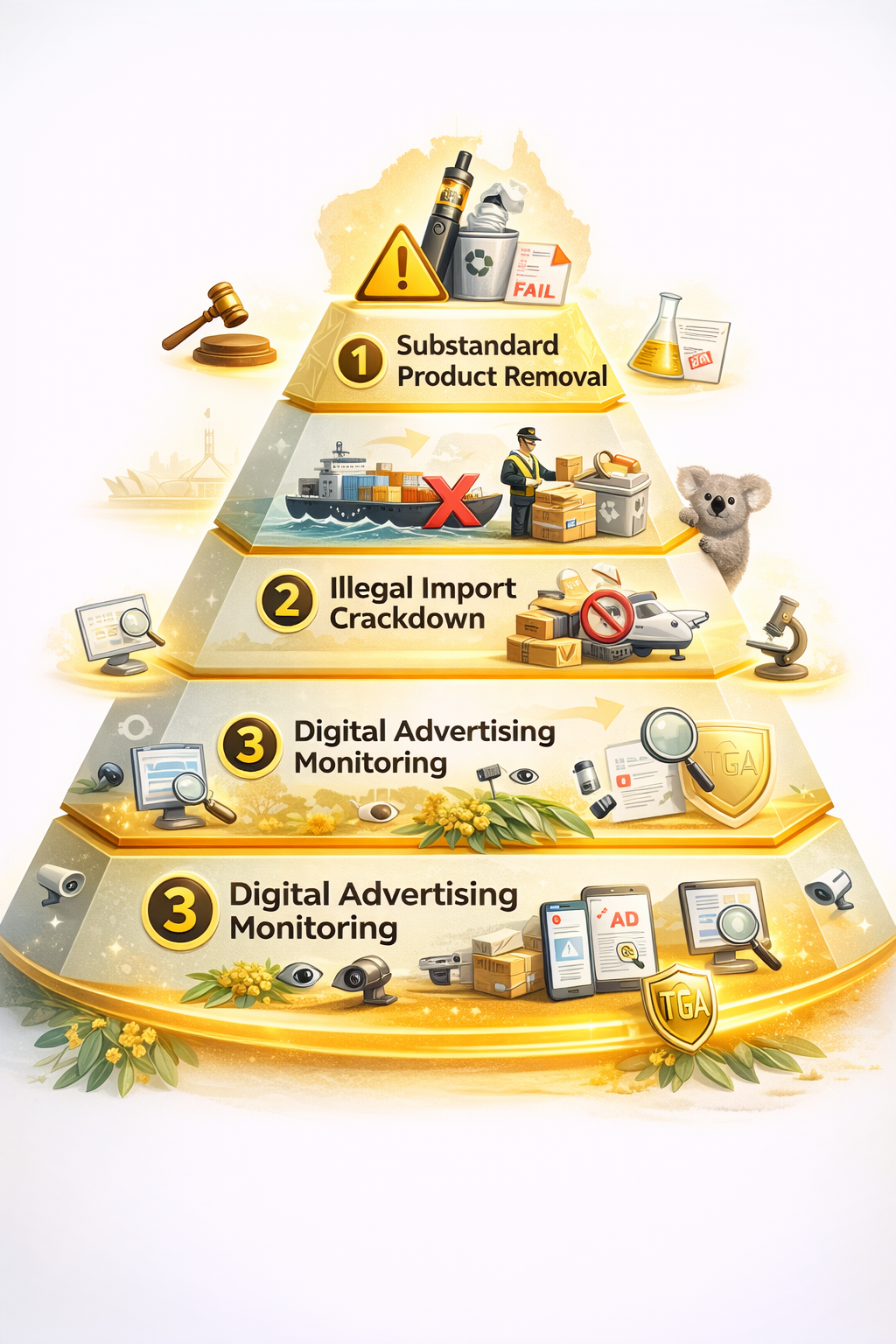
In January 2026, the TGA released its Compliance Principles for 2026–27, explicitly listing vaping goods among 12 priority areas. Key actions include [1][5][7]:
- Active monitoring of digital advertising (social media, influencers).
- Cracking down on unapproved and substandard products sold via e-commerce.
- Countering AI-generated misinformation and deceptive endorsements.
- Strengthening enforcement against non-compliant suppliers.
The priority list is reviewed quarterly, with vaping remaining a sustained focus [1].
3. Product Standards: What Legal Vapes Must Meet
The Therapeutic Goods (Standard for Therapeutic Vaping Goods) (TGO110) Order has been progressively strengthened [4][8]. From 1 July 2025, all therapeutic vapes supplied in Australia must comply with enhanced standards:
Flavours restricted to mint, menthol, tobacco. Prohibited ingredients list expanded (vitamin E acetate, diacetyl, etc.) [8].
Plain pharmaceutical-style packaging. Child-resistant closures mandatory. Warning labels covering prescribed formats [4].
Maximum concentration 50mg/mL (down from 100mg/mL). Accurate labelling required [8].
Names attractive to children (e.g., candy references) or implying safety/health benefits are banned [8].
No therapeutic vaping good has yet been included in the Australian Register of Therapeutic Goods (ARTG), meaning the TGA has not evaluated any product for safety and efficacy [4].
4. Advertising & Promotion: Total Ban
The Public Health (Tobacco and Other Products) Act 2023 extended advertising bans to cover e-cigarettes comprehensively [2]. Key provisions:
- All e-cigarette advertising prohibited (including internet and telecommunications) [2].
- Point-of-sale display banned.
- Social media promotion, influencer content, and sponsorships outlawed.
- TGA actively monitors digital channels for violations [1].
Commercial possession and supply outside authorised channels attract significant penalties, with enforcement targeting manufacturers, importers, and distributors rather than individual users [3].
5. 2018 vs 2026: Side-by-Side Comparison
| Aspect | 2018 Position | 2026 Position |
|---|---|---|
| Regulatory Framework | Fragmented, state-based; nicotine as poison (S7) | Unified national therapeutic goods framework [8] |
| Retail Access | Specialty shops, convenience stores (non-nicotine); personal import (nicotine) | Pharmacy-only supply; prescription or pharmacist advice depending on strength/age [6] |
| Import Rules | Personal import allowed with prescription | Total ban on non-therapeutic imports; licensed import only [8] |
| Product Standards | Minimal; no national standards | TGO110 therapeutic standards: flavours limited, plain packaging, ingredient controls [4] |
| Enforcement Focus | Post-sale, consumer-level | Border-first, supply chain accountability; 2026–27 TGA priority [1] |
| Advertising | Limited restrictions, inconsistent | Comprehensive ban across all media including digital [2] |
What This Means for Australian Vapers (2026)
The cumulative effect of these changes is a "structural reset" rather than a simple ban. Practical implications [3][6]:
- Legal access only via pharmacies (with or without prescription depending on strength and state).
- Flavours limited to mint, menthol, tobacco—fruit and ice flavours no longer legally available.
- Illicit market remains active; possession for personal use not criminalised federally, but state penalties vary [3].
- TGA actively targeting online sellers and social media promotions—consumers should verify sources.
Frequently Asked Questions
Are all vapes illegal in Australia now?
No. Therapeutic vapes for smoking cessation or nicotine dependence are legal when obtained through pharmacies, in compliance with TGO110 standards. Non-therapeutic vapes (including all flavoured disposables) are illegal to supply, possess commercially, or import [6].
Can I still buy flavoured vapes like Blueberry Ice?
Not legally through Australian pharmacies—only mint, menthol, and tobacco flavours are permitted. Flavoured vapes available from other retailers are illicit and may contain undisclosed ingredients [3][8].
What are the penalties for possessing illegal vapes?
Federally, possession for personal use is not criminalised. However, some states (e.g., SA, QLD) have their own penalties. The primary enforcement target is commercial supply, not individual users [3].
How do I know if a vape product is legal?
Legal therapeutic vapes are only sold in pharmacies, in plain packaging, with flavours limited to mint/menthol/tobacco. If it's sold online, in a convenience store, or has fruit/candy flavours, it's illegal [6].
Will the rules change again in 2026?
The TGA's 2026–27 compliance priorities reaffirm vaping as an enforcement focus, but no major legislative changes are currently scheduled. However, the priority list is reviewed quarterly [1].
Conclusion: A Decade of Transformation
Australia's vaping regulations between 2018 and 2026 represent a deliberate, layered policy evolution. What began as a focus on nicotine scheduling has become a comprehensive therapeutic goods framework controlling importation, retail supply, product quality, and advertising. The result is a system where legal vapes are pharmacy-only, therapeutically regulated, and stripped of consumer-facing appeal—a stark contrast to the open market of just eight years prior [8].
For those navigating these rules, staying informed through official channels (TGA, state health departments, and trusted resources like the Alcohol and Drug Foundation) is essential [3].
📚 References & trusted sources
- Royal Australian College of General Practitioners (RACGP) – TGA reveals compliance priorities 2026–27, January 2026. racgp.org.au [TGA 2026–27 focus on vaping goods]
- Sydney Health Law (University of Sydney) – Innovation down under: Australia's tobacco control reforms, June 2025. sydneyhealthlaw.com [PHTOP Act advertising bans]
- Alcohol and Drug Foundation (ADF) – Australian vaping rules and regulations, updated November 2025. adf.org.au [State-by-state access rules, penalties]
- Pharmacy Daily – New standards for nicotine vapes, June 2025. pharmacydaily.com.au [TGO110 enhanced standards July 2025]
- 2Firsts / TGA – Australian government updates enforcement priorities: vaping goods on 2026 priority list, January 2026. 2firsts.com [TGA compliance principles 2026–27]
- The Sydney Children's Hospitals Network (NSW Health) – Laws in Australia (vaping and smoking), updated February 2026. health.nsw.gov.au [Current e-cigarette laws, pharmacy access]
- Pharmacy Daily – Med cannabis, vapes on TGA priority list, January 2026. pharmacydaily.com.au [TGA 2026–27 compliance themes]
- Sage Journals (Perspectives in Public Health) – A short history of e-cigarette policy in Australia, May 2025. journals.sagepub.com [Peer-reviewed legislative history 2018–2025]
- Pharmacy Daily – Vape reforms ineffective? (TGA data on seizures), June 2025. pharmacydaily.com.au [9 million illegal vapes seized]
All sources are government, academic, or health organisations. Retrieved March 2026.
© 2026 G'DayVape — Australian vape knowledge, grounded in clarity. Always adult-only.
 RELX Pod