

Blog
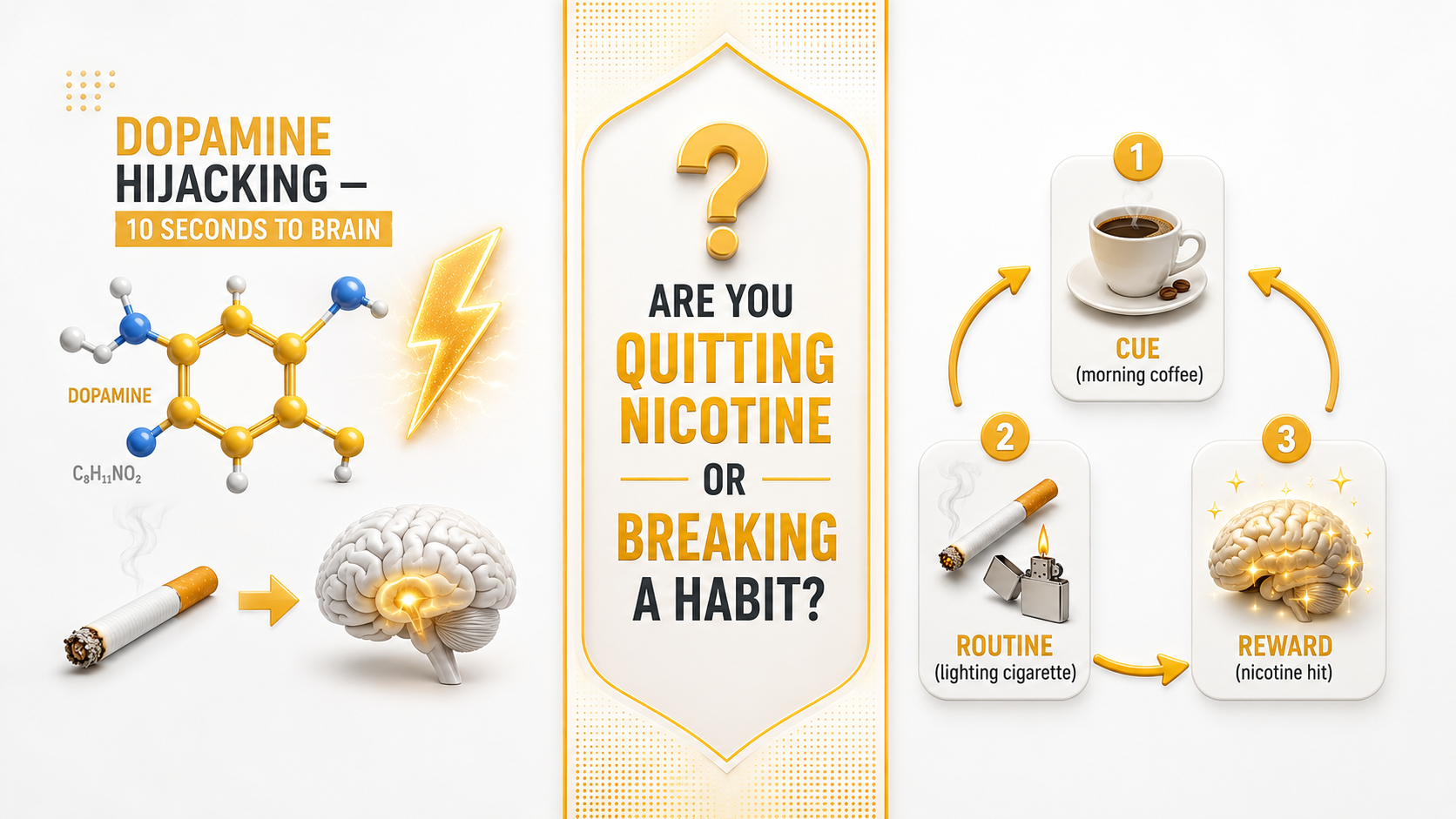
Are You Quitting Nicotine or Breaking a Habit? The Psychology Behind Smoking

The Surprising Truth About Nicotine Withdrawal
One of the most persistent myths in smoking cessation is that physical nicotine withdrawal is severe and long‑lasting. In reality, the physical component of nicotine addiction is relatively mild and short‑lived compared to many other substances. Physical withdrawal symptoms peak within the first 72 hours and typically resolve within 2–4 weeks. The craving that persists for months or years after quitting is not driven by physical dependence — it's driven by the psychological habit that your brain has automated over thousands of repetitions.
Dopamine Hijacking: How Smoking Rewires Your Brain
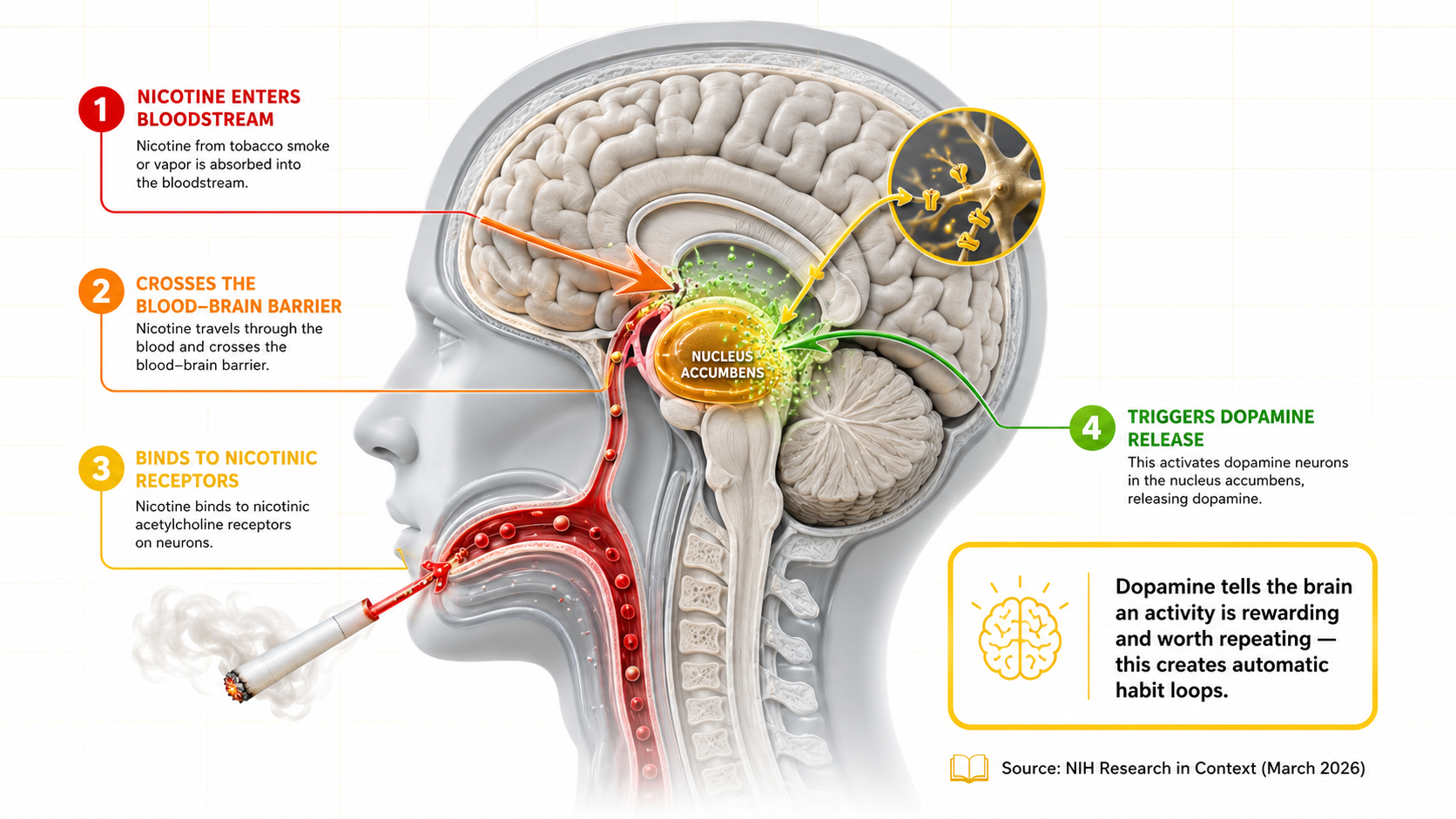
Every time nicotine enters your system, it triggers a burst of dopamine in the nucleus accumbens — the brain's reward centre [5]. This dopamine signal tells your brain that the activity is rewarding and worth repeating. Over time, your brain rewires itself to make that behaviour automatic, linking the reward to specific environmental cues [5]. This conditioning process creates powerful habits that operate below conscious awareness. The brain compensates for repeated dopamine surges by reducing baseline reward sensitivity — like turning down the volume on a loud radio [5]. This means that over time, only the drug can provide a normal level of reward, and a person needs more of it to get the same effect. Meanwhile, the drug weakens brain circuits responsible for self‑control, making cravings stronger and relapse more likely [5].
The Habit Loop: Cue, Routine, Reward
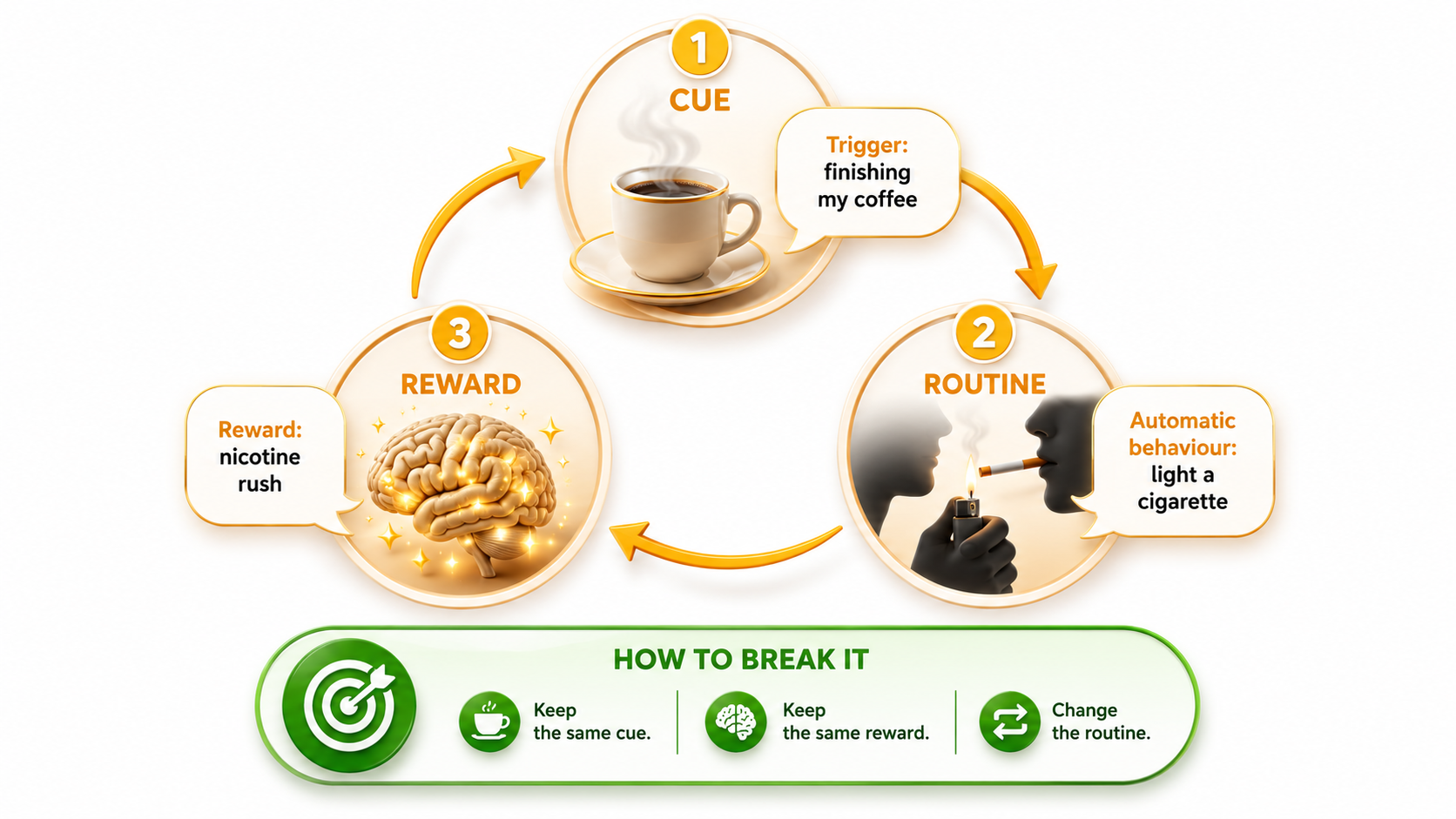
Charles Duhigg's "habit loop" framework — cue, routine, reward — offers a practical map for understanding and changing smoking behaviour [3]. A cue (morning coffee, finishing a meal, stress, socialising) triggers the automatic routine of lighting a cigarette, which delivers a reward (the dopamine hit). Over time, encountering the cue creates a subconscious craving that drives the routine. As Duhigg writes, "Use the same cue, provide the same reward, change the routine" [3]. Common smoking cues include a cup of coffee, an alcoholic drink, driving in a car, work stress, finishing a task, socialising with other smokers, and the after‑dinner moment [8].
The reward is not just nicotine — it can also be the feeling of taking a break, social connection, stress relief, or the simple satisfaction of completing a ritual. Identifying the true reward is essential for finding effective substitutes.
Are You Quitting Nicotine or Breaking a Habit? Both — But Not Equally
Successful quitters address both the chemical and psychological components, but the balance shifts over time. The two components also have different recurrence patterns. Physical withdrawal peaks in the first few days and subsides within weeks. Psychological relapse, triggered by encountering familiar cues, can occur months or even years after quitting. This explains why someone can be smoke‑free for six months and still relapse when they walk into their old pub or have a stressful day at work. It's not physical withdrawal — it's the automated habit being reactivated by a powerful cue.
The body's need for nicotine to avoid withdrawal symptoms. Peaks 2‑3 days after quitting. Resolves within 2‑4 weeks. Managed with NRT or gradual nicotine reduction.
Automated cue‑triggered behaviour stored in basal ganglia. Persists for months or years. Managed by changing routines, avoiding cues, and replacement behaviours.

Cue Labelling: Name It to Tame It
A 2026 UC Irvine study published in Neuropsychopharmacology found that a simple mental technique called "cue labelling" — mentally naming the triggers that make you want to smoke — can reduce cravings and the associated brain activity [4]. In the study, 50 adults who smoked daily completed tasks while undergoing brain scans. When participants selected words that labelled features of cigarettes or smoking scenes — "puff", "pack", "smoke", "mouth", "lighter", "ashtray" — self‑reported craving dropped and brain scans revealed reduced activity in the precuneus, a region linked to cigarette craving [4]. "Name it to tame it! Putting feelings into words has long been known to calm emotions," said study author Golnaz Tabibnia [4]. "Our latest paper shows that putting what we crave into words can help calm cravings" [4].
Goldberg's Golden Rule: Same Cue, Same Reward, Different Routine
Behavioural economist David Goldberg offers a simple but powerful framework for breaking smoking habits. He calls it the "Golden Rule" of habit change: keep the same cue, keep the same reward, but change the routine. For example, if morning coffee triggers a cigarette craving, don't try to eliminate the coffee — change what you do during the coffee. Instead of lighting a cigarette, spend 5 minutes on a crossword puzzle, listen to a podcast, chew gum, or sip ice water through a straw. Over time, the cue will become associated with the new routine, and the craving for a cigarette will fade.
Practical Strategies to Replace the Habit — Not Just Suppress It
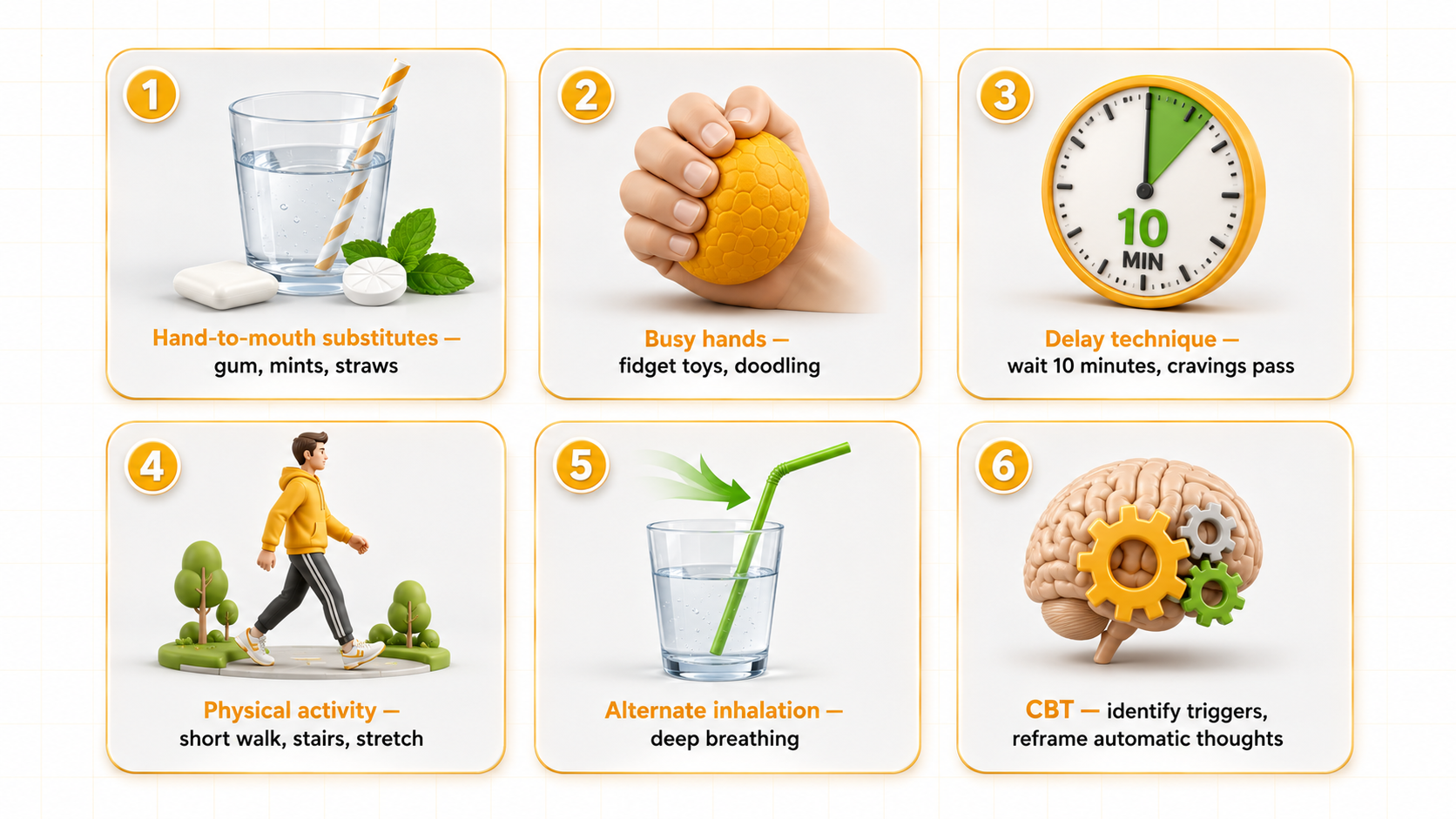
Chewing gum, sucking on mints, drinking water through a straw, toothpicks, carrot sticks. Keep your mouth busy.
Stress balls, fidget toys, doodling, knitting, pen spinning. Occupied hands can't reach for a cigarette.
When a craving hits, commit to waiting 10 minutes before acting. Most cravings pass within 3‑5 minutes [10].
Even a single workout can help suppress cravings. Short walks, stretching, stair climbing [11].
Deep breathing exercises, drinking through a straw, using a non‑nicotine inhalator — mimics the physical act without the drug.
Identifies triggers, develops coping skills, and reframes automatic thoughts about smoking [7].
The Neuroscience of Relapse: Why Cues Are So Powerful
The cue‑reactivity phenomenon explains why relapse is so common even after successful withdrawal. The brain forms strong associations between smoking and environmental cues — places, people, times of day, emotional states. When a former smoker encounters these cues, the brain automatically reactivates the craving response. Nicotine self‑administration research has shown that visual cues can be at least as important as nicotine itself in sustaining drug‑seeking behaviour [8]. In one study, smokers showed greater activity in the brain's reward region and areas associated with motor actions of smoking when exposed to cigarette cues, compared to nonsmokers [8]. Approach bias modification (ApBM) — a computerised training that retrains automatic cognitive responses to smoking cues — has shown promise as an intervention for managing cue‑reactivity [7].
When to Use Nicotine Replacement vs Behavioural Strategies
There's no one‑size‑fits‑all approach. The combination of behavioural support plus evidence‑based pharmacotherapy has the strongest evidence for smoking cessation [11]. A 2026 meta‑analysis of 4005 participants across nine RCTs found that combining bupropion with NRT significantly improved short‑term abstinence rates (risk ratio = 1.35, 95% CI 1.22‑1.50) [10]. Cognitive Behavioral Therapy (CBT) helps smokers identify triggers, manage cravings, and develop practical strategies to quit [7].
Patches, gum, lozenges, inhalators. Best for managing physical withdrawal symptoms in the first weeks. Use for 8‑12 weeks with a step‑down plan.
Group therapy, quitline support, CBT. Best for identifying triggers, developing replacement routines, and maintaining motivation over months.
Designing Your Personal Habit‑Change Plan
Use this four‑step framework to customise your own approach.
- Step 1 — Identify your top 3 smoking cues. Morning coffee? After meals? Driving? Stress? Social situations? Write them down.
- Step 2 — For each cue, identify the real reward. Is it the nicotine hit, the break from work, the social connection, the hand‑to‑mouth action? Be honest.
- Step 3 — Choose a replacement routine that delivers the same reward. Use the cue‑labelling technique to calm the craving, then substitute a new action.
- Step 4 — Practise the delay technique. When a craving hits, set a timer for 10 minutes. If you still want to smoke after 10 minutes, reconsider — but most cravings pass.
Product Recommendations — Tools to Support Habit Change
RELX pod systems are designed for adults transitioning away from combustible tobacco. These devices are draw‑activated, compatible with nicotine salt pods, and require no technical knowledge.
RELX Devices — Simple, Reliable Transition Tools
RELX Pods — Nicotine Strength Options for Step‑Down
※ Prices are for reference only and may be subject to change. Please check the website for the latest offers. 🔞 Age verification required.
🇦🇺 G'DayVape: We support adult smokers making informed choices about harm reduction. All products are 100% authentic and intended for adult use only. Nicotine is addictive — the healthiest choice is to never use any nicotine product. For those who smoke, switching completely to a non‑combustible product reduces exposure to the most harmful chemicals in tobacco smoke.
📚 References & trusted sources
- UC Irvine / Neuropsychopharmacology (2026) – Cue labelling reduces cigarette cravings. [4]
- NIH Research in Context (March 2026) – Treating addiction. [5]
- Charles Duhigg / The Power of Habit – Habit loop framework. [3]
- NIH / Current Topics in Behavioral Neurosciences (2015) – Nicotine withdrawal heritability. [6]
- BMJ Best Practice (2026) – Smoking cessation. [11]
- Frontiers / Healthline (2026) – CBT for smoking cessation. [7]
- ScienceDirect (2002) – Cue dependency of nicotine self‑administration. [8]
- Prairie Mountain Health (2026) – Break up with nicotine. [10]
- Epocrates (2026) – Even a single workout may help people quit smoking. [11]
- Addictive Behaviors (2026) – NRT + bupropion meta‑analysis. [10]
- Scientific Reports (2026) – Approach bias modification for smoking cue‑reactivity. [7]
© 2026 G'DayVape — adult vaping knowledge, grounded in clarity. Always adult‑only.
 RELX Pod