

Blog
What Can Replace Smoking? Everyday Habit Alternatives That Work

The Replacement Principle: Why Willpower Alone Isn't Enough
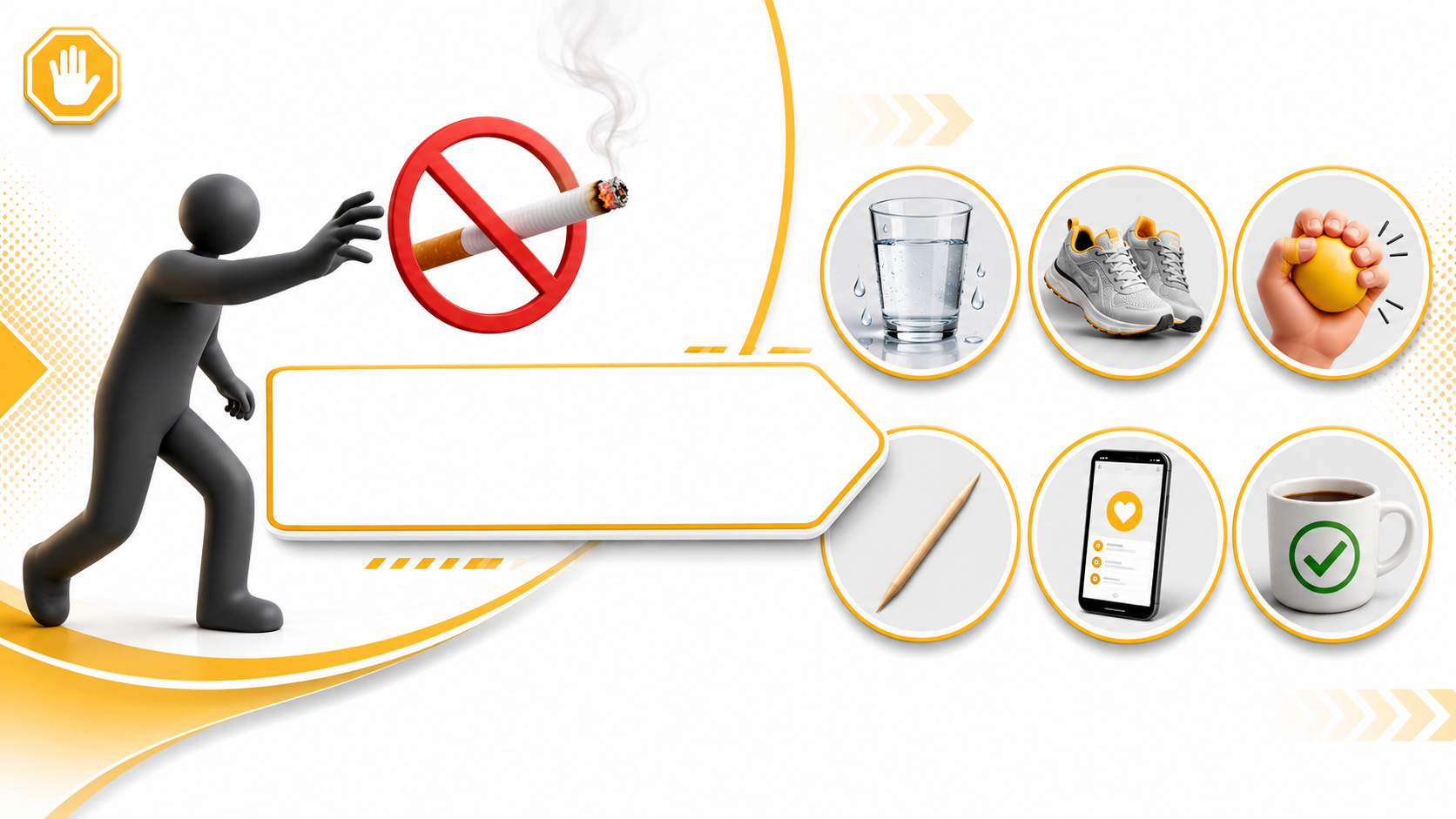
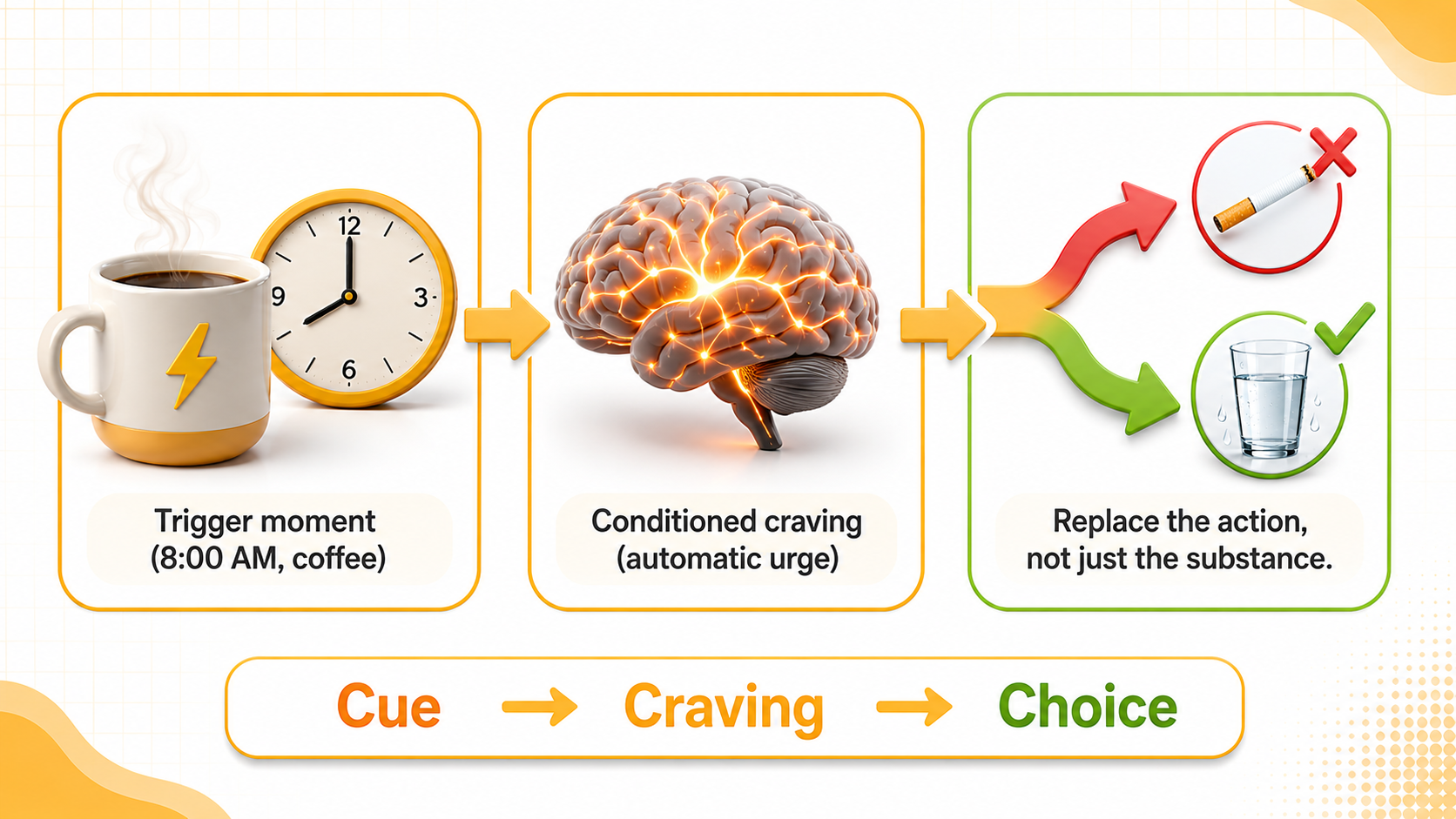
The reason most quit attempts fail isn't a lack of determination, but a failure to replace the ritual. Your brain links smoking to specific moments: that first morning coffee, the break after finishing a task, the stress of a phone call, the wind‑down at the end of the day. When you simply remove cigarettes without filling those moments, the empty space pulls you back toward the old behavior. Effective quitting is about building new habits that satisfy the same underlying needs in healthier ways. That replacement principle — swap rather than suppress — is the foundation of sustainable cessation.
Category 1: Hand‑to‑Mouth Substitutes — Replace the Physical Ritual
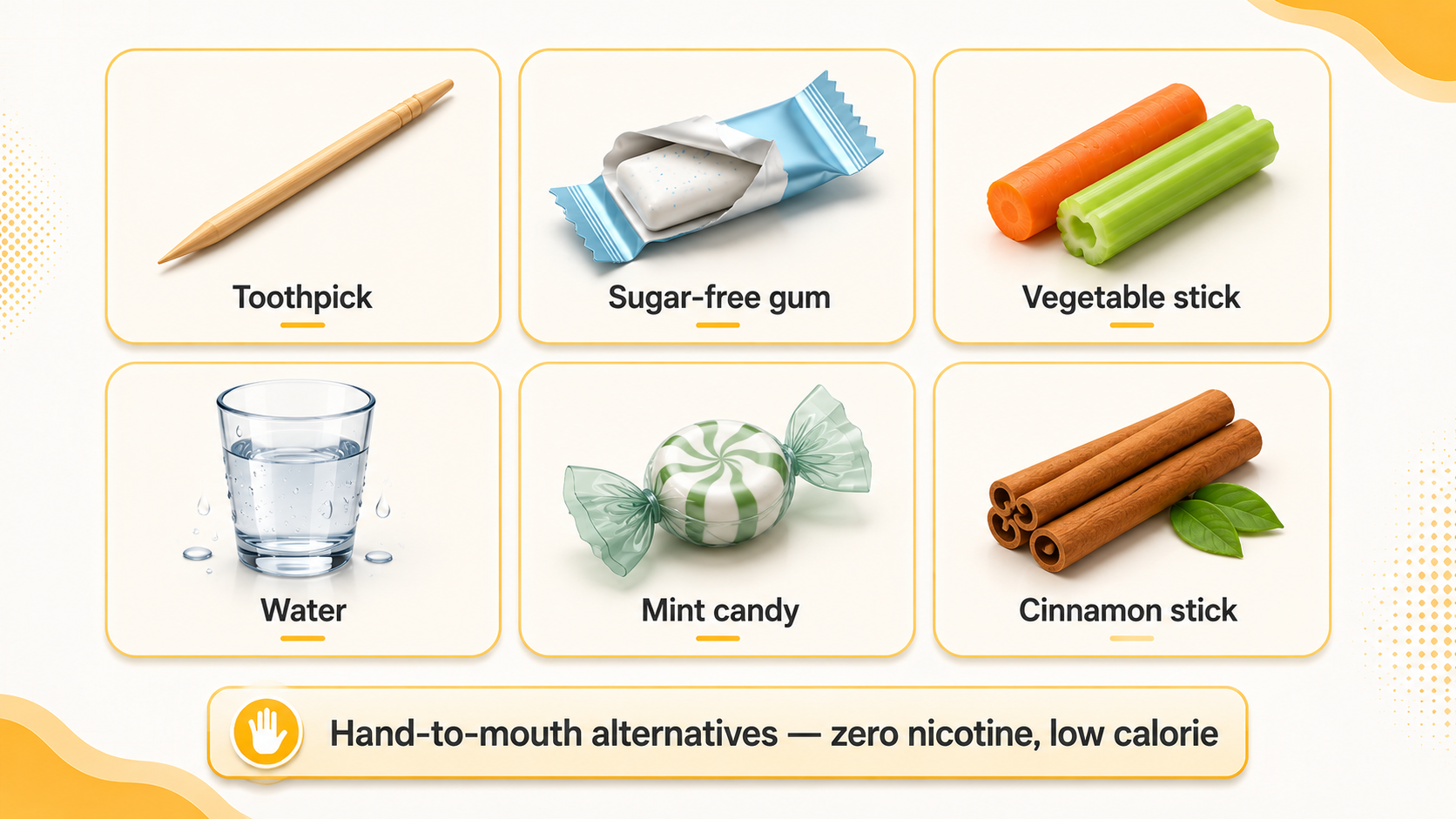
For many smokers, the physical act of bringing something to the mouth is as ingrained as the nicotine itself. When you quit, that hand‑to‑mouth motion leaves a void. Replacing it with low‑calorie oral substitutes helps manage cravings triggered by habit rather than chemistry. Options that work for many former smokers include:
Hydrates, flushes toxins, and gives your hands something to hold. A tall glass of water first thing in the morning is an effective swap for the after‑wake‑up cigarette.
Chewing something satisfying occupies the mouth without calories. Keep gum in your car, desk drawer, and bag.
Carrots, celery, peppers, or radishes provide satisfying texture without empty calories.
The fresh, clean taste lingers for 20‑30 minutes and makes smoking feel unappealing.
Some quilters use cinnamon‑soaked toothpicks, which offer mild flavor and oral stimulation without nicotine [3].
Reproduces the draw resistance of a cigarette without any harmful chemicals. Fill the glass with ice water or a low‑calorie beverage.
Category 2: Keep Your Hands Occupied — Retrain Idle Fingers
Idle hands trigger automatic reaching for a cigarette. Behavioral specialists recommend using physical objects to redirect that nervous energy, especially during the first two weeks of quitting when manual habits are strongest.
Keep one on your desk, in your car, and by your sofa. When a craving hits, squeeze it for 60‑90 seconds until the urge passes.
Keep a small notepad and pen nearby. Doodling occupies both hands and the part of the brain that drives automatic habits.
Produces a tangible reward (a finished piece) and keeps both hands occupied for hours. Many former smokers find it particularly effective for evening wind‑down times.
Small, silent, and portable. Keep a textured worry stone in your pocket to rub when you feel a craving building.
Category 3: Movement & Physical Activity — Outrun the Craving
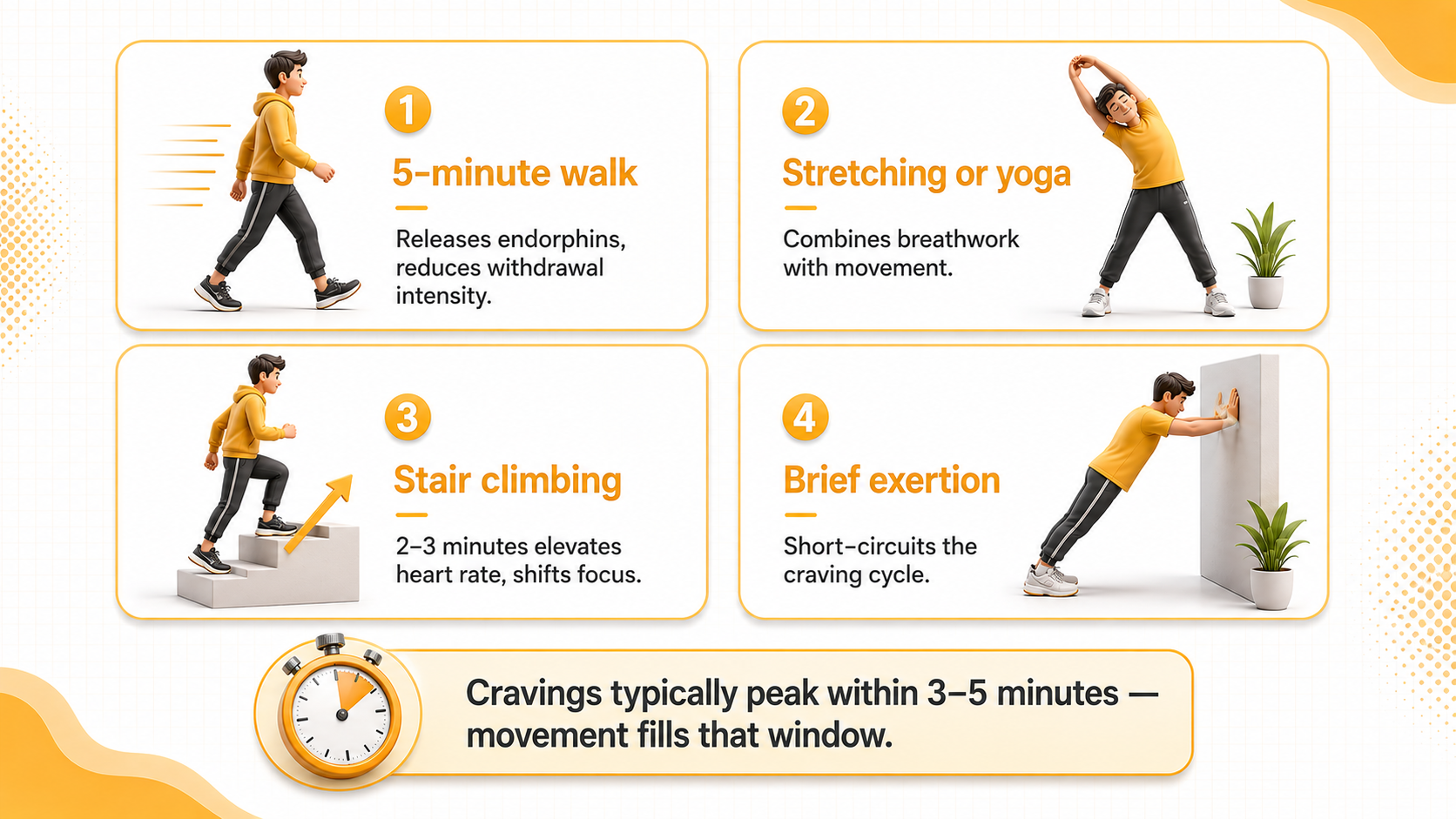
Physical activity is one of the most effective immediate responses to a nicotine craving. Research from Harvard Medical School finds that regular exercise reduces a person's risk of developing addictive behaviors and makes quitting those addictions more likely to be successful [11]. Even a brisk 5‑minute walk can shift brain chemistry, release endorphins, and reduce withdrawal symptom intensity. Movement also helps manage weight gain concerns — a common worry that discourages some from quitting.
- Quick walks — When a craving strikes, walk to the end of the block and back.
- Stretching or yoga — Deep breathing combined with gentle movement reduces stress and resets your nervous system.
- Push‑ups against a wall — A brief burst of exertion while staying at your desk can short‑circuit a building craving.
- Stair climbing — 2‑3 minutes of stair climbing elevates heart rate and redirects attention.
Category 4: Mindfulness, Breathing & Stress Management
Stress is one of the most powerful triggers for smoking relapse. When you feel tense, your body automatically reaches for the old habit that provided relief. Learning to manage stress without cigarettes is essential. Deep breathing interrupts the stress response and gives your brain an alternative calming pathway. Try the 4‑7‑8 method: inhale for 4 seconds, hold for 7 seconds, exhale for 8 seconds. Repeat four times. Smartphone apps like Calm or Headspace offer 2‑3 minute guided meditations designed specifically for craving management.
Set a timer for 120 seconds. Inhale deeply, exhale slowly. Repeat until the timer ends. This short reset can change your emotional state completely.
Many free apps track your smoke‑free days, show health milestones achieved, and provide on‑demand craving‑busting exercises.
Create a specific playlist of relaxing instrumental music that you listen to only when a craving hits. Over time, the music itself becomes a conditioned cue for calm.
Write down what triggered the craving, how intense it was (1‑10), and what you did instead. This builds self‑awareness and weakens the automatic habit loop.
Category 5: Social Support & Accountability
Quitting in isolation is harder. Research consistently shows that social support and professional counseling significantly improve quit success rates. A 2024 meta‑analysis found that mailout smoking cessation support improved the odds of quitting at six to twelve months (OR 1.43), with interventions lasting longer than 12 weeks being more effective (OR 1.57) [11]. Support works by reducing feelings of loneliness, providing accountability, and offering practical strategies when you feel stuck.
- Tell friends and family — Specificity helps: "I'm quitting on [date]. Please don't offer me cigarettes or smoke around me for the next month."
- Join online quit communities — Forums and Facebook groups provide 24/7 support from people going through the same experience.
- Use free quitline counseling — Professional counselors are trained to help you identify triggers and develop replacement strategies.
- Find a quit buddy — Pair up with someone who is also quitting. Text each other when cravings hit.
Category 6: Nicotine Replacement Therapy — Manage the Chemistry
Nicotine replacement therapy (NRT) delivers controlled doses of nicotine without the carcinogens in tobacco smoke. Clinical trial data shows that NRT increases quit rates compared to placebo, routine care, or no NRT (279 vs 210 per 1000 people) [1]. A 2026 meta‑analysis of 4005 participants across nine randomized controlled trials found that combining bupropion with NRT significantly improved short‑term abstinence rates (risk ratio = 1.35, 95% CI 1.22‑1.50) [10]. The Cochrane review provides high‑certainty evidence that nicotine e‑cigarettes increase quit rates compared to NRT, with an absolute effect of an additional 3 quitters per 100 people [10].
Provides steady base‑level nicotine over 16‑24 hours. Reduces withdrawal symptoms throughout the day. Apply each morning to clean, dry skin.
Fast‑acting relief for breakthrough cravings. Chew until you feel a tingling sensation, then park between cheek and gum.
Replicates the hand‑to‑mouth ritual and draw of a cigarette while delivering a measured dose of nicotine.
Using a long‑acting patch plus a short‑acting gum or lozenge is more effective than either alone [10].
Designing Your Personal Replacement Plan
The strategies above work best when combined into a daily plan tailored to your specific triggers. Here's a simple framework to build your own replacement toolkit.
- Step 1 — Identify your top 3 trigger moments. Morning coffee? After meals? Driving? Work stress? Social events?
- Step 2 — Assign a specific replacement behavior to each trigger. Not a vague idea like "be healthier" — a concrete action like "drink a full glass of water before reaching for coffee."
- Step 3 — Stock your environment with the tools you'll need. Sugar‑free gum in the car. Stress ball on your desk. Walking shoes by the door. Water bottle always filled.
- Step 4 — Start NRT 2‑4 weeks before your quit date. Build stable nicotine levels before you stop smoking completely.
- Step 5 — Practice the "5‑minute rule." When a craving hits, tell yourself you can smoke in 5 minutes if you still want to. Distract yourself during those 5 minutes. Most cravings pass within this window.
Product Recommendations — Tools for Your Quit Journey
RELX pod systems are designed for adults transitioning away from combustible tobacco. These devices are draw‑activated, compatible with nicotine salt pods, and require no technical knowledge.
RELX Devices — Simple, Reliable Transition Tools
RELX Pods — Nicotine Strength Options for Step‑Down
※ Prices are for reference only and may be subject to change. Please check the website for the latest offers. 🔞 Age verification required.
🇦🇺 G'DayVape: We support adult smokers making informed choices about harm reduction. All products are 100% authentic and intended for adult use only. Nicotine is addictive — the healthiest choice is to never use any nicotine product. For those who smoke, switching completely to a non‑combustible product reduces exposure to the most harmful chemicals in tobacco smoke.
📚 References & trusted sources
- Cochrane Database of Systematic Reviews (2025) – Smoking cessation interventions initiated during hospitalization. cochranelibrary.com [NRT increases quit rates: 279 vs 210 per 1000 people]
- Cochrane Database (2025) – Electronic cigarettes for smoking cessation (Lindson N). cochranelibrary.com [High‑certainty evidence: nicotine EC increases quit rates vs NRT, additional 3 quitters per 100]
- NIH / Current Topics in Behavioral Neurosciences (2015) – Nicotine withdrawal heritability. pmc.ncbi.nlm.nih.gov [Heritability of nicotine dependence risk: 50‑75%]
- Harvard Health Publishing – Why exercise if I'm not losing weight? health.harvard.edu [Regular exercise reduces risk of addictive behaviors and makes quitting more likely]
- JAMA Internal Medicine (2025) – Integrating tobacco treatment into lung cancer screening. pubmed.ncbi.nlm.nih.gov [30‑40% success rate with comprehensive support]
- NHS Inform (2026) – Stop smoking medication. nhsinform.scot [NRT alongside cutting down to quit, types of NRT]
- Preventive Medicine (2024) – Mailout smoking cessation support meta‑analysis. pubmed.ncbi.nlm.nih.gov [OR 1.43, longer interventions >12 weeks more effective OR 1.57]
- Addictive Behaviors (2026) – NRT + bupropion meta‑analysis. sciencedirect.com [RR 1.35 for combined therapy, 4005 participants]
- Texas Tech University / Behavioral Economics – Oral substitutes as behavioral replacements. depts.ttu.edu [Cinnamon sticks, straws, toothpicks as competition with cigarettes]
© 2026 G'DayVape — adult vaping knowledge, grounded in clarity. Always adult‑only.
 RELX Pod