

Blog
Disposable vs Pod Vape Components: What’s Inside & How They Work

The Four Core Components Common to All Vapes
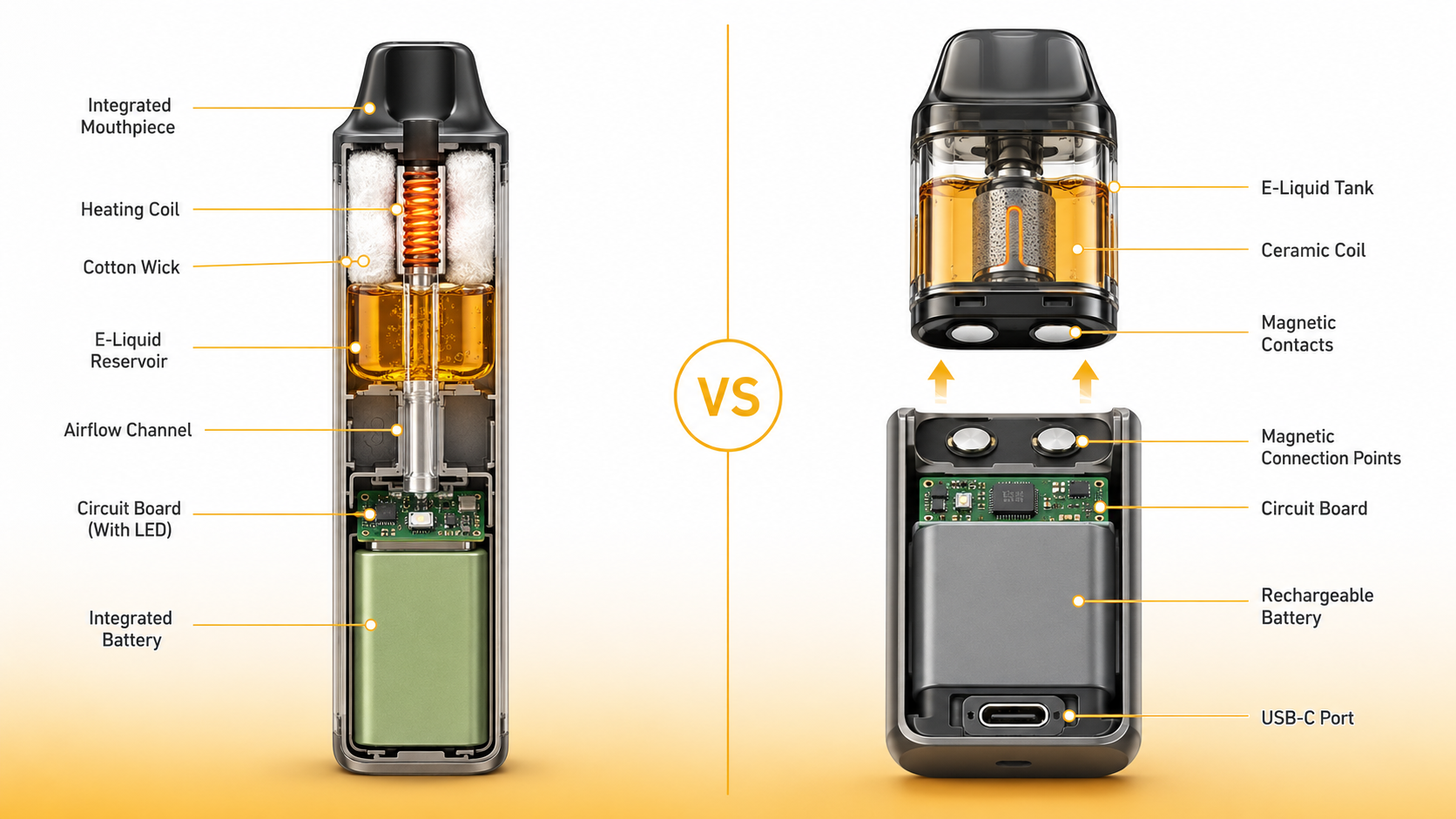
Every vaping device, whether disposable or refillable, contains four essential components that work together to turn e-liquid into inhalable vapour. These components are the battery, atomizer (coil), e-liquid reservoir, and activation mechanism. However, the way these components are implemented and how long they last differs dramatically between device types.
Anatomy of a Disposable Vape
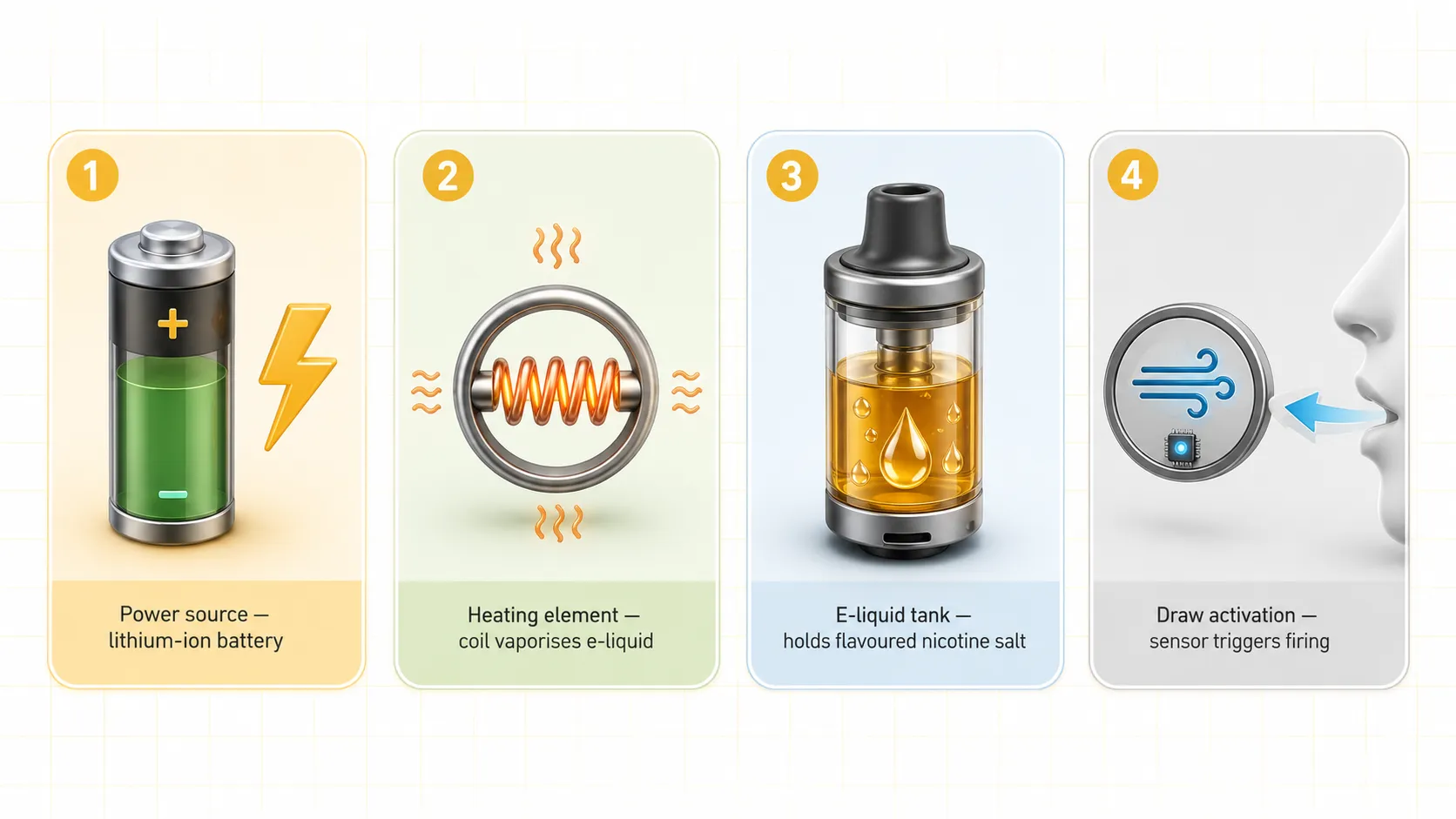
A disposable vape is a single-unit device where every component — battery, atomizer, e-liquid, and mouthpiece — is sealed together and discarded together. Disposable vapes come pre-filled and pre-charged, ready to use straight out of the box. They require zero maintenance and are designed to be used until the e-liquid runs out or the battery dies, then thrown away.
Component Breakdown of a Disposable Vape
- Battery: A non-rechargeable lithium-ion battery, typically rated between 300mAh and 2000mAh depending on the device. Once depleted, the entire device is discarded.
- Atomizer (Coil): Integrated heating element (often mesh or standard coil) embedded in the device, surrounded by cotton or ceramic wicking material. Cannot be replaced or cleaned.
- E-Liquid Reservoir: A sealed tank pre-filled with nicotine salt e-liquid. Capacities range from 2mL to over 20mL on high-puff models. The tank is non-refillable.
- Activation Mechanism: Most disposables use a draw-activated airflow sensor. When you inhale, the sensor detects pressure change and triggers the battery to power the coil.
- Circuit Board: A small PCB (printed circuit board) that controls power delivery, often includes an LED indicator for battery status.
- Mouthpiece: Integrated drip tip moulded into the device body — not removable or replaceable.
Anatomy of a Pod System (Closed Pod / Rechargeable)
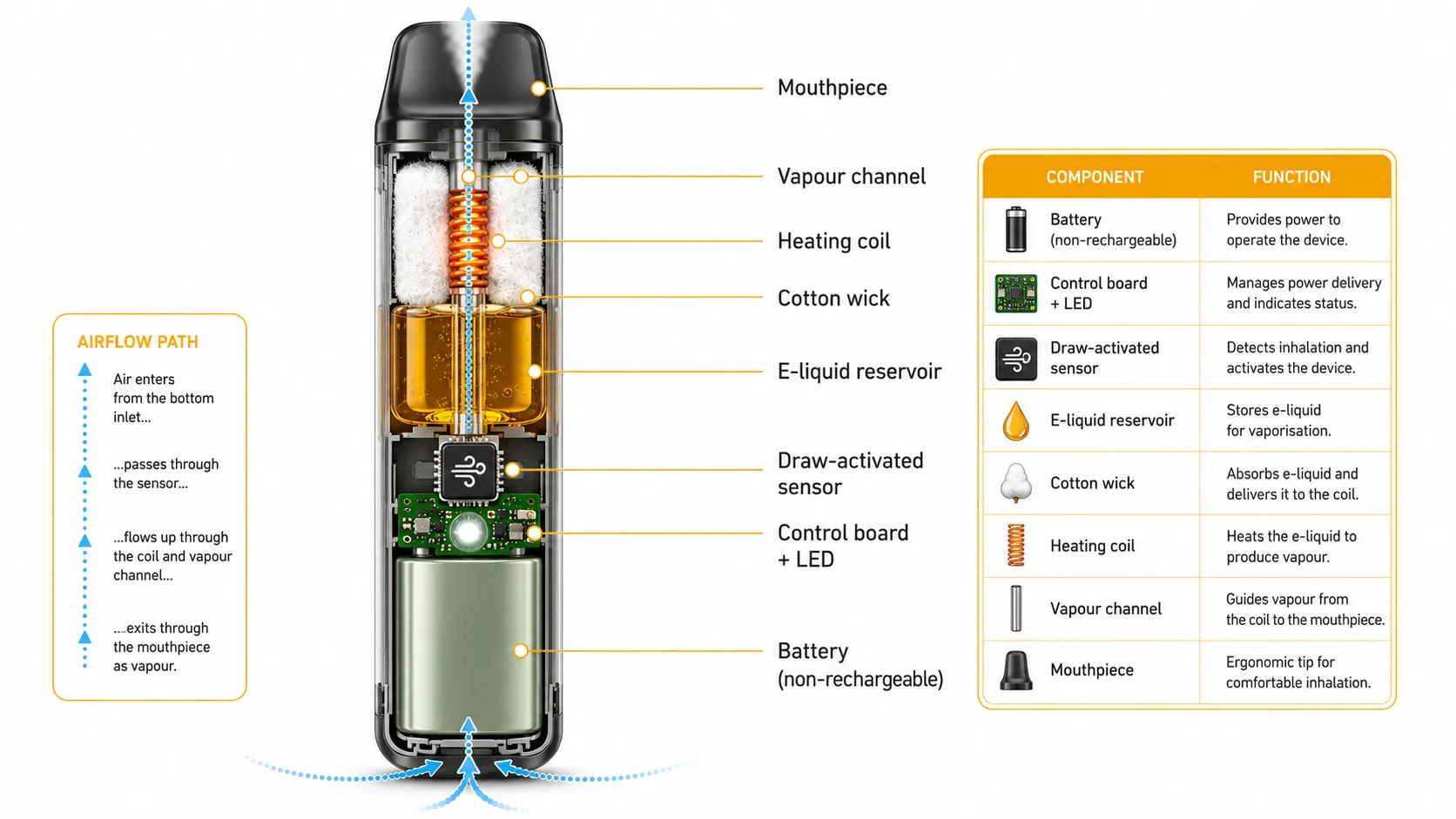
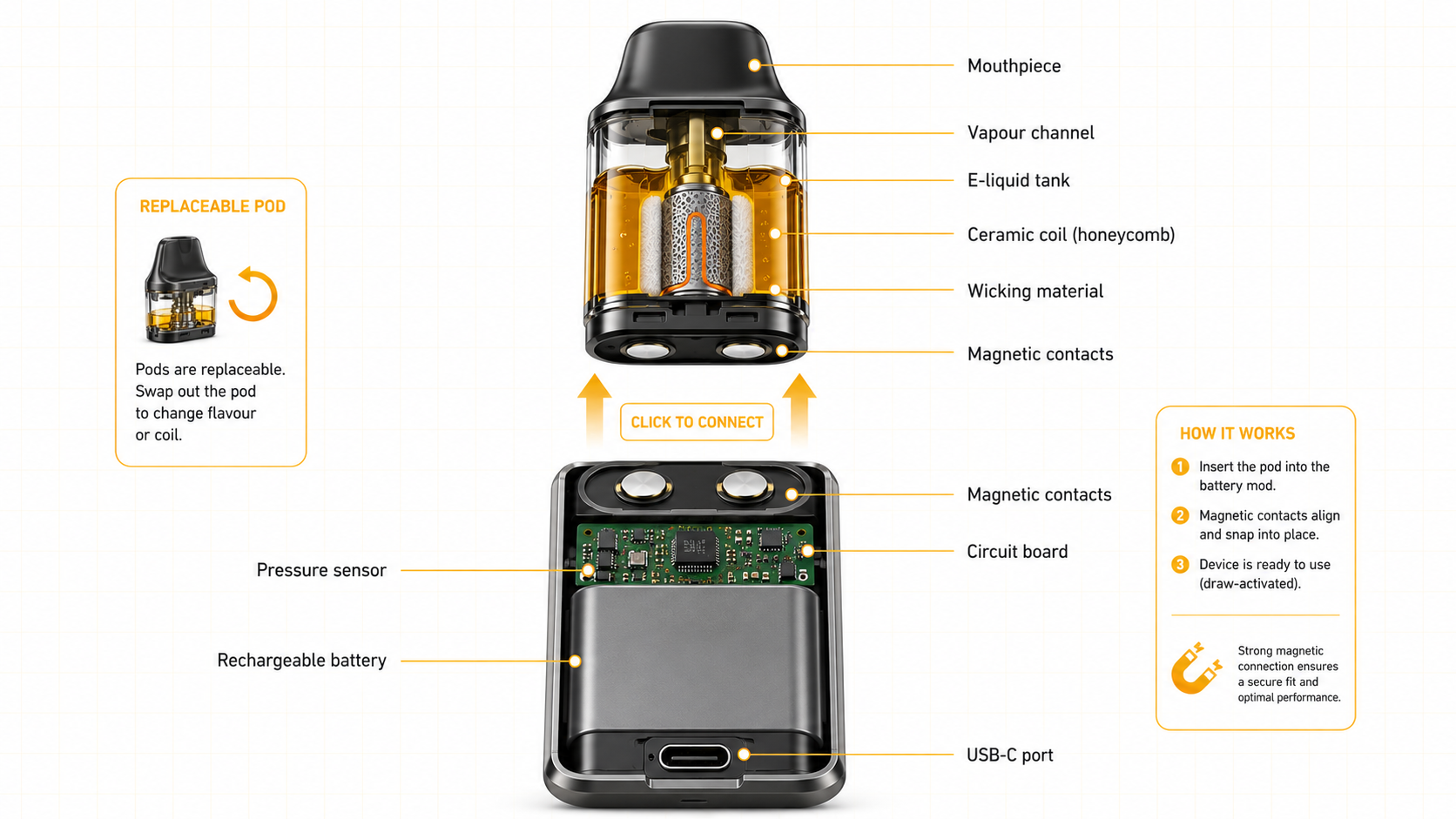
A pod system is a two-part device consisting of a rechargeable battery mod and a replaceable pod that contains the e-liquid and coil. When the pod is empty, you discard only the pod, not the battery. This modular design dramatically reduces waste and lowers long-term operating costs. Pod systems are available in closed (pre-filled) and open (refillable) formats, though this guide focuses on closed pods used with RELX devices.
Component Breakdown of a Pod System
- Battery Mod (Reusable): Contains a rechargeable lithium-ion battery (typically 350mAh to 440mAh), a USB-C charging port, a control chip, and magnetic contacts for pod connection. Can be recharged hundreds of times over 1-2 years of use.
- Pod (Replaceable): The disposable cartridge that snaps into the battery mod. It contains the e-liquid reservoir, the atomizer coil, and the mouthpiece in one sealed unit.
- Atomizer (Coil in Pod): Heating element inside the pod, often using advanced ceramic or cotton wick technology. In RELX devices, the pod utilises a ceramic heating element with a 0.01mm honeycomb structure for even heat distribution and consistent flavour from first to last puff.
- E-Liquid Reservoir (in Pod): Pre-filled sealed tank inside the pod, typically 1.9mL capacity, delivering approximately 600-650 puffs per pod.
- Activation Mechanism: Draw-activated pressure sensor inside the battery mod. When you inhale, the sensor detects airflow and triggers the battery to send power to the pod's coil. RELX devices use a pressure-sensitive system with 0.001atm sensitivity for near-instant activation.
- Magnetic Connection: Pods attach to the battery mod using strong magnets, ensuring secure connection and easy pod swapping without screwing or threading.
- LED Indicator: Located on the battery mod, shows battery level and charging status.
Component Comparison: Disposable vs Pod System
| Component | Disposable Vape | Pod System (Closed) |
|---|---|---|
| Battery Type | Non-rechargeable lithium-ion | Rechargeable lithium-ion (via USB-C) |
| Battery Lifespan | Single use — discarded with device | Hundreds of charge cycles — device lasts 1-2 years |
| Coil / Atomizer | Integrated, non-serviceable, cotton wick | Integrated into pod — new coil with each pod |
| Coil Technology | Standard mesh or coil (varies by brand) | Advanced ceramic or cotton wick options |
| E-Liquid Refilling | Not possible — sealed tank | Not applicable (closed pod — pre-filled) |
| Pod Replacement | Whole device replaced | Replace only the pod; device body reusable |
| Activation | Draw-activated (airflow sensor) | Draw-activated (airflow sensor) |
| Circuit Board | Simple PCB with LED indicator | Advanced chipset with power regulation, battery protection |
| Waste Generated | High — entire device discarded each time | Low — only pods discarded; battery reused |
Core Components Explained in More Detail
Battery & Power Management
Both device types use lithium-ion batteries, but their approach differs fundamentally. Disposable vapes embed a non-rechargeable battery that ends up in landfill after a single use — a major environmental concern. Pod systems, by contrast, use rechargeable batteries designed to be recharged hundreds of times. In RELX devices, the battery mod houses a 350mAh to 440mAh cell with built-in power regulation and overcharge protection. The chipset automatically adjusts power output to the coil's resistance, ensuring consistent vapour production from first puff to last.
Atomizer / Coil Technology
The atomizer is the heating element that vaporizes e-liquid. In disposables, the coil is integrated into the device and cannot be replaced. Once the coil degrades (usually after the e-liquid runs out), the whole device is discarded.
In pod systems, the coil is built into the pod. Each time you replace an empty pod, you're also replacing the coil with a fresh one. This means no coil cleaning, no coil building, and no worrying about burnt taste from an old coil.
Coil material also varies. Many disposables use standard cotton-wick coils. Advanced pod systems like RELX use ceramic heating elements. Ceramic coils have a porous structure with countless tiny pores that hold e-liquid evenly, providing consistent flavour and preventing dry hits. According to RELX, their ceramic atomizers use a honeycomb structure with each pore sized 0.01mm in diameter, ensuring uniform heating and flavour delivery from first to last puff.
Alternatively, some RELX pods use cotton wick atomizers, which deliver vapour at a gradually rising temperature, releasing flavour layer by layer for a more dynamic experience. The choice between ceramic and cotton comes down to personal preference: ceramic offers consistent, full-bodied flavour, while cotton delivers a warmer, evolving flavour profile.

E-Liquid Reservoir
Disposable vapes have a sealed e-liquid tank that cannot be refilled. When the liquid runs out, the entire device is thrown away. Tank capacities vary widely, from 2mL on smaller disposables to over 20mL on high-puff models.
Pod systems use a replaceable pod that serves as both the e-liquid reservoir and the atomizer housing. In closed pod systems like RELX, the pod is pre-filled with 1.9mL of e-liquid and is sealed — you cannot refill it. When the pod is empty, you simply click in a new pod. This design eliminates messy refills and ensures you always have a fresh coil with every new pod.
Activation Mechanism (Airflow Sensor)
Both disposable and pod vapes typically use draw-activated firing. Inside the device, a small pressure sensor (often a MEMS sensor or a silicone membrane switch) detects the change in air pressure when you inhale through the mouthpiece. This signal triggers the battery to send power to the coil, heating the e-liquid instantly.
In RELX devices, the pressure-sensitive system has a sensitivity of 0.001atm, resulting in extremely fast activation — vapour is produced almost immediately after you start inhaling. This responsive firing is one reason pod systems feel so natural to former smokers.

Circuit Board & Chipset
Behind every functional vape is a small printed circuit board (PCB) that controls power delivery, monitors battery status, and manages safety protections. In disposables, the PCB is simple — often just a basic MOSFET switch and an LED indicator. In pod systems, the circuitry is more sophisticated, including overcharge protection, short-circuit protection, low-voltage cut-off, and sometimes adjustable power modes (as in the RELX Infinity 2 with its three power settings: Eco 6.5W, Smooth 8W, and Boost 10W). These chipsets ensure consistent power output even as the battery level drops, providing a uniform vaping experience from fully charged to nearly empty.
How the Two Types Work: Step-by-Step
Disposable Vape Firing Sequence
- User inhales through the integrated mouthpiece.
- Airflow sensor detects pressure change.
- Circuit board sends current from the fixed battery to the coil.
- Coil heats to 200–250°C, vaporising e-liquid from the saturated wick.
- User inhales vapour; LED may illuminate to indicate firing.
- Process repeats until e-liquid or battery is exhausted; then entire device is discarded.
Pod System Firing Sequence
- User inhales through the pod's mouthpiece (pod securely attached to battery mod).
- Airflow sensor inside the battery mod detects pressure change.
- Chipset regulates power delivery to the pod's coil based on coil resistance and selected power mode.
- Coil heats to optimal temperature, vaporising e-liquid from the integrated wick.
- User inhales vapour; LED indicator may show battery level.
- When pod is empty, user discards only the pod and clicks in a fresh pod. Battery mod remains in use.
Component Longevity & Cost Impact
Understanding component lifespan helps explain why a pod system is more economical than disposables over time. With a disposable vape, you're paying for a new battery, new coil, and new circuit board every time. With a pod system, you pay once for the rechargeable battery mod (which lasts 1-2 years) and then only for the replacement pods (which contain the coil and e-liquid).
The RELX Essential 2, for example, has a 380mAh rechargeable battery designed to last over 500 charge cycles. At 600-650 puffs per pod, each full charge can deliver multiple pods worth of use before needing to be recharged. This modular design means less waste going to landfill and lower monthly costs for regular vapers.
Product Recommendations: Pod Systems with Advanced Components
RELX Rechargeable Devices — Built to Last
RELX Pods — Pre-filled, Replaceable Cartridges
※ Prices are for reference only and may be subject to change. Please check the website for the latest offers. 🔞 Age verification required.
🇦🇺 G'DayVape: We help adult vapers understand the technology behind their devices. All products are 100% authentic and intended for adult use only.
📚 References & trusted sources
- RELX Official – Understanding Atomizers: Cotton vs. Ceramic. relxnow.ch [Ceramic atomizer properties, honeycomb structure, cotton vs ceramic flavour profiles]
- RELX UK – How Do Vape Pods Work? relxnow.co.uk [Two‑part construction, cartridge and battery operation, pressure‑sensitive activation]
- ZEN VAPE – RELX Pod System Specifications. zenvape.ca [350mAh battery, 0.001atm pressure sensitivity, honeycomb ceramic coil, 0.01mm pore size]
- Ecigator – Vaping POD Systems Guide: Types, Safety & E‑Liquid Rules (2026). ecigator.com [POD system anatomy, two‑component breakdown, refillable vs disposable trade‑offs]
- iPlayVape – Vaping Guide – What Vape Should I Buy? m.iplayvape.com [Disposable vs pod system definitions, pre‑filled vs rechargeable differences]
- Clutch Vape – Disposable Vapes vs Vape Pods: Which Is Better For You? clutchvape.ca [Open vs closed pod systems, maintenance requirements, component differences]
- Vaporesso – Cotton vs. Ceramic Coils: What's the Difference? store.vaporesso.com [Cotton and ceramic coil characteristics, heat‑up time comparison, flavour delivery analysis]
© 2026 G'DayVape — adult vaping knowledge, grounded in clarity. Always adult‑only.
 RELX Pod