
Blog
Why the First Puff Feels Stronger: Vapor Saturation & Coil Dynamics Explained

The Primer Puff Phenomenon: What Actually Happens?
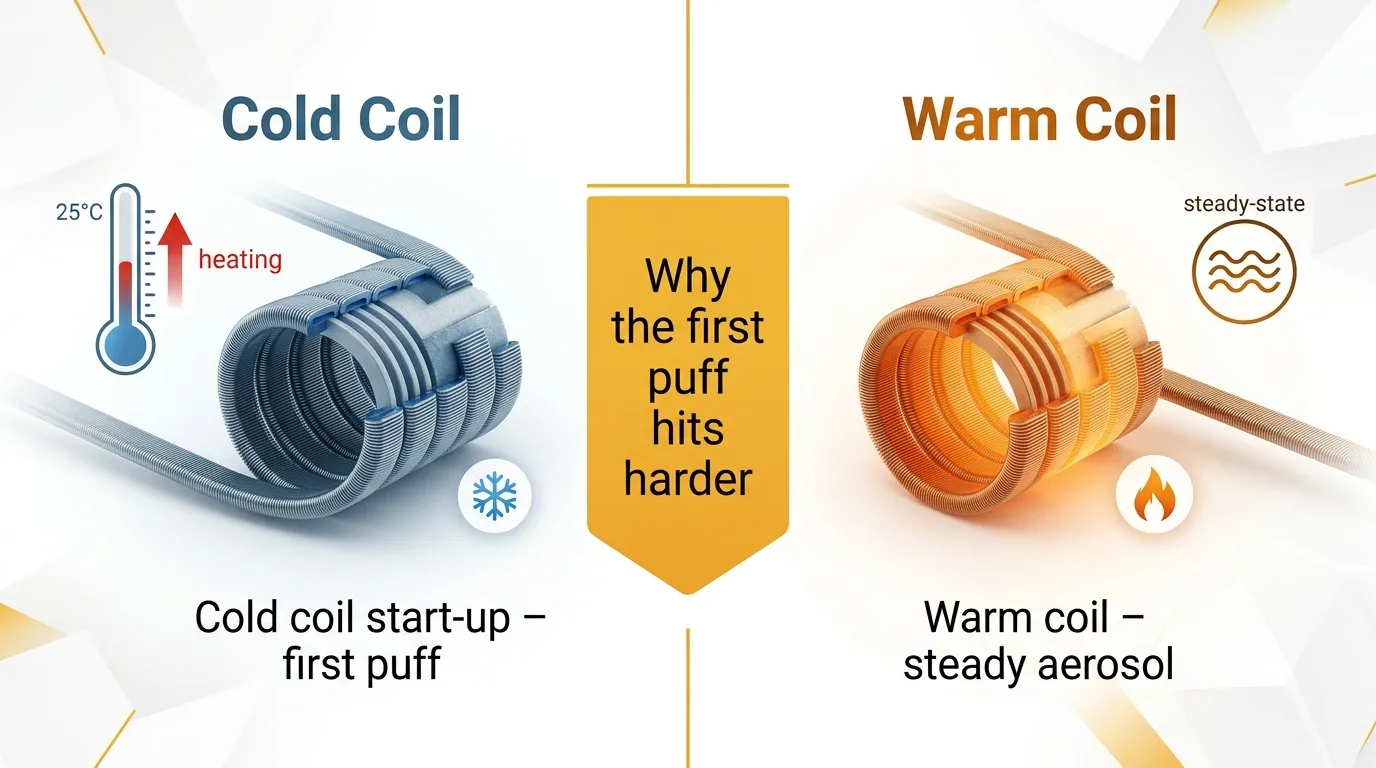
If you've ever taken a puff from a vape that hasn't been used for a while, you've likely noticed that the first hit feels stronger — more flavour, more vapour, sometimes even a warmer sensation. This is often called the "primer puff" effect. The reason isn't psychological; it's physical. Research on e-cigarette aerosol generation has identified several mechanisms that explain why the first puff from a cold atomizer coil differs from subsequent puffs.
1. Cold Coil Start-Up: The Temperature Ramp
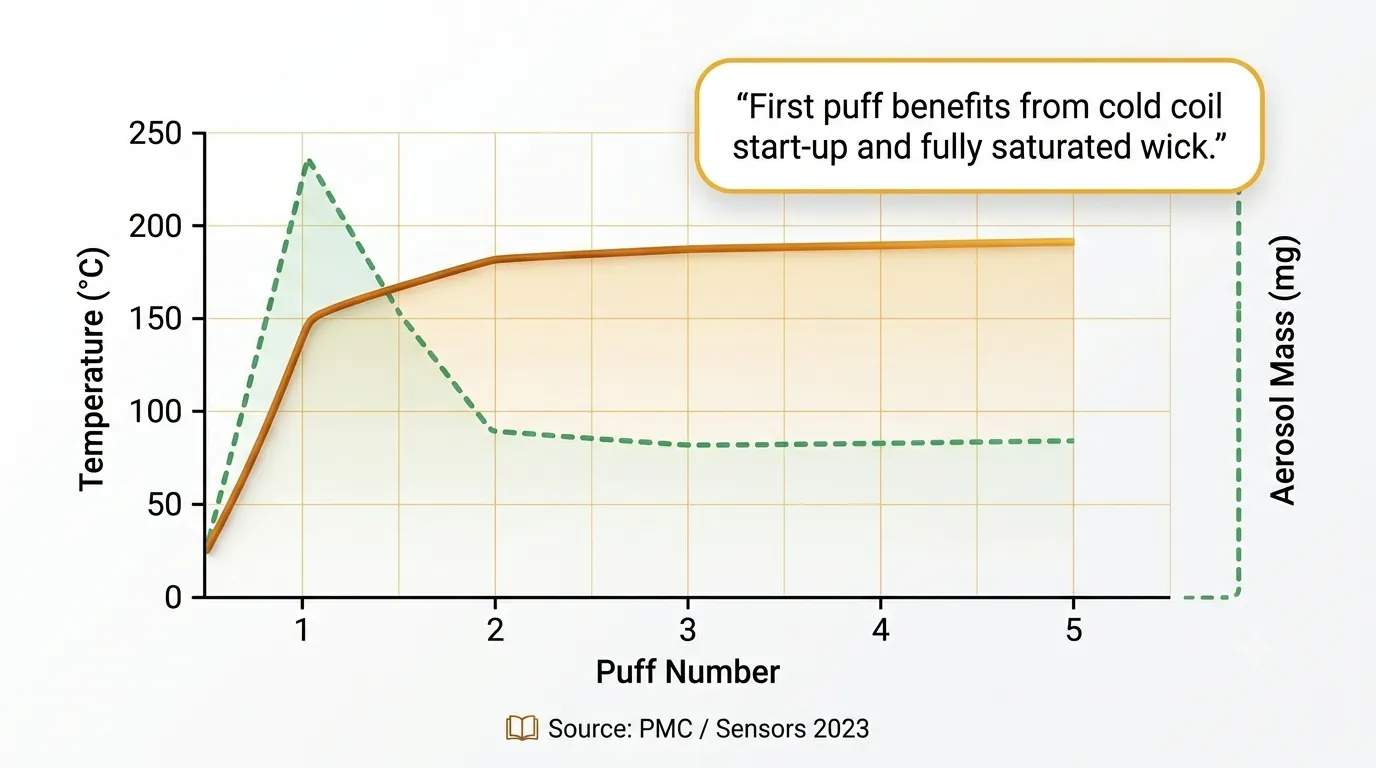
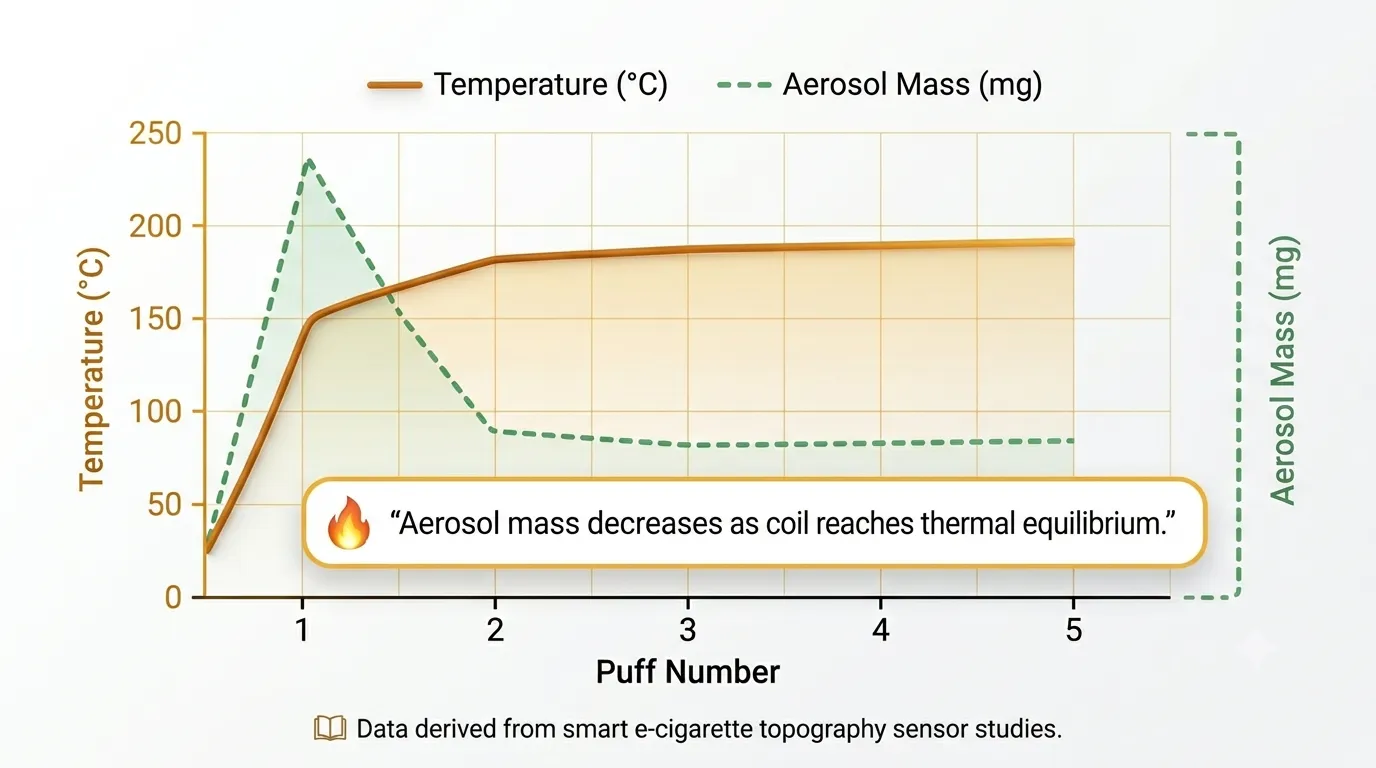
The most fundamental factor is temperature. When you first fire a cold device, the coil begins at room temperature and must heat up to the e-liquid's boiling point (typically 188–292°C for PG/VG mixtures). Research using optical sensors has shown that the signal intensity — a proxy for aerosol production — monotonically increases as coil power and therefore temperature increase. The first puff occurs during this initial heating phase, when the coil is still warming up and the e-liquid is being rapidly heated from a cold state.
A study on the dynamic behavior of ceramic coil atomizers found that the e-aerosol size distribution reaches a relatively stable state at approximately 3 seconds after the trigger of a puff, with the Sauter Mean Diameter stabilizing at around 0.42 μm. This suggests that aerosol production during the very first moments of a puff — especially the initial fraction — is different from the steady-state aerosol generated later in the same puff or in subsequent puffs.
Experimental data from a smart e-cigarette study shows that during the first three puffs from a cold atomizer coil, the mass of Total Particulate Matter (TPM) is higher in the initial puffs and gradually decreases as the coil warms up to a stable operating temperature.
2. Wick Saturation and Priming Effect
When a device sits idle for a period of time, the wick becomes fully saturated with e-liquid. During the first puff, the wick is at maximum saturation, providing an abundant supply of e-liquid to the coil. This initial burst of saturation can lead to more vigorous vaporisation and a denser aerosol. Research shows that the e-liquid consumption per puff is influenced by the power supplied to the atomizer coil.
As you continue vaping, the wick's saturation level decreases slightly, and the e-liquid consumption stabilises to a steady-state rate. This is why the first puff — with a fully saturated wick — often produces a stronger hit than the second or third puff. The phenomenon is similar to the "priming" step recommended for new coils: allowing the wick to fully saturate before firing prevents dry hits and ensures optimal vapour production.
3. Vapor Saturation Ratio: The Overlooked Factor
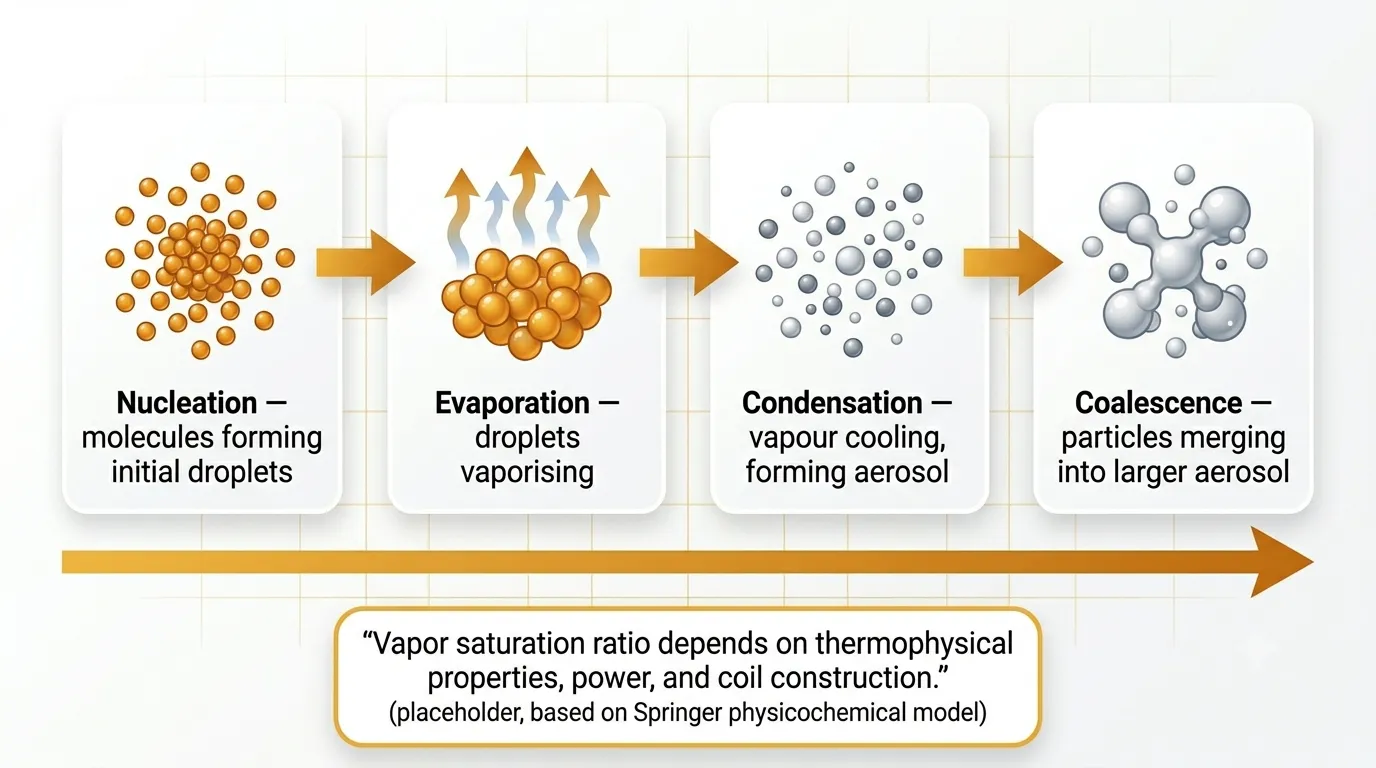
The vapor saturation ratio plays a key role in aerosol generation. According to physicochemical models of e-cigarette aerosol formation, the generation process is expressed by the detailed interplay between nucleation, evaporation, condensation, and coalescence. The saturation ratio depends on the thermophysical properties of the individual compounds in the e-liquid, the vaping topography, the power applied to the heating coil, and its construction.
During the first puff from a cold coil, the vapor saturation ratio may be higher because the temperature gradient between the coil and the surrounding air is steeper. This can lead to more rapid nucleation and condensation, producing a denser aerosol with different particle size characteristics.
4. Particle Size Distribution
The particle size distribution of the aerosol also changes during the first puff. E-cigarette aerosols typically exhibit a bimodal particle size distribution: nanoparticles (11–25 nm count median diameter) and submicron particles (96–175 nm count median diameter). However, transient measurements show that particle size distributions during the initial phase of a puff can differ from the steady-state distribution.
Research using high-time-resolution systems has revealed that particle sizes from electronic cigarettes range from 5 to 1000 nm. During the first puff, the distribution may skew toward larger or smaller particles depending on the thermal state of the coil, contributing to the different mouthfeel and throat hit sensation.
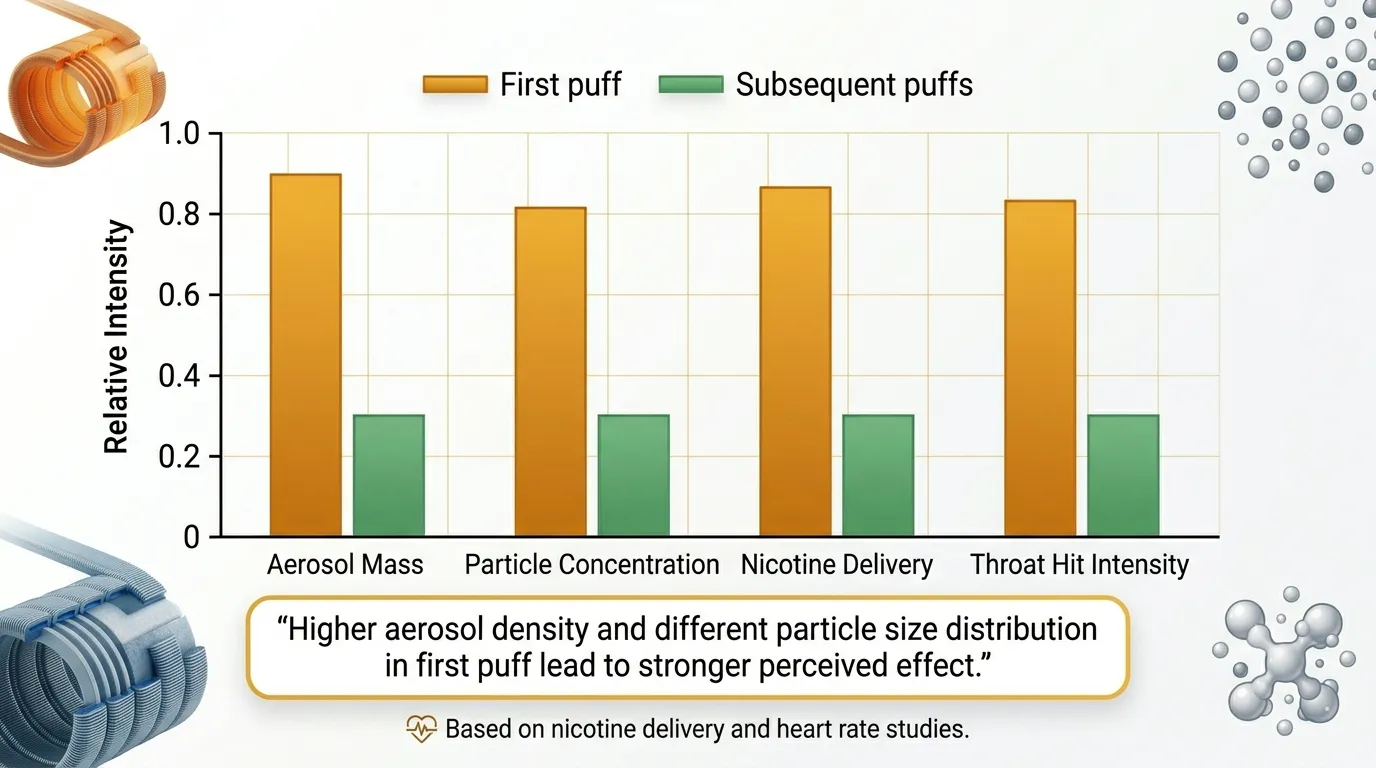
Coil begins at room temperature; rapid heating phase produces burst of aerosol with different particle characteristics.
Fully saturated wick provides abundant e-liquid supply; first puff benefits from maximum saturation.
Higher vapor saturation ratio during first puff leads to more rapid nucleation and condensation.
Transient particle size distribution differs from steady-state; aerosol reaches stability at ~3 seconds.
Why Subsequent Puffs Feel Weaker
After the first puff, several things change:
- The coil is now warm: Once the coil reaches operating temperature, the rapid heating phase is complete. Subsequent puffs occur at thermal equilibrium.
- The wick is slightly less saturated: The initial burst of vapour uses some of the e-liquid in the wick.
- Vapor saturation ratio stabilises: The atomizer chamber is now warmer, and the nucleation and condensation dynamics become more consistent.
Product Recommendations — Devices with Consistent Performance
Understanding coil dynamics can help you choose devices that deliver consistent performance. RELX pod systems use advanced ceramic coil technology that maintains stable temperature and aerosol production across multiple puffs.
RELX Devices — Advanced Ceramic Coil Technology
RELX Pods — Pre-filled with Consistent Formulation
※ Prices are for reference only and may be subject to change. Please check the website for the latest offers. 🔞 Age verification required.
🇦🇺 G'DayVape: We support adult vapers with accurate, science-based information about how vaping devices work. All products are 100% authentic and intended for adult use only.
📚 References & trusted sources
- Sensors (PMC / MDPI) – Effects of atomizer conditions (cold or warmed-up coil) on e-cigarette aerosol output. [1]
- PubMed / PLOS ONE – Electronic cigarette power affects count concentration and particle size distribution. [2]
- Springer / Physicochemical Aspects of Aerosol Generation – E-cigarette aerosol generation process and dynamics. [3]
- ScienceDirect / Experimental investigation on ceramic coil atomizer – Dynamic behavior and microscopic characteristics of aerosol. [4]
- PubMed / ACS Chem Res Toxicol (2021) – Impact of e-Liquid Composition, Coil Temperature, and Puff Topography on Aerosol Chemistry. [5]
© 2026 G'DayVape — adult vaping knowledge, grounded in clarity. Always adult‑only.
 RELX Pod